
The Tiny Pests That Can Ruin Your Mint (And How to Stop Them)
Aphids on mint are small, soft-bodied insects that suck sap from your plants, causing stunted growth, curling leaves, and a sticky residue called honeydew. Here’s a quick summary of how to deal with them:
- Blast them off with a strong jet of water from a hose
- Spray with insecticidal soap or a diluted neem oil solution
- Attract natural predators like ladybugs and lacewings to your garden
- Plant garlic or chives nearby to repel aphids naturally
- Harvested mint is still safe to use — just rinse well and boil if needed
You step out to grab a handful of fresh mint for your mojito or syrup, and something looks off. The leaves are curling. There’s a sticky film on the stems. And on the undersides of the leaves — tiny green insects, clustered together, quietly draining your plant.
That’s the mint aphid (Ovatus crataegarius), and it moves fast.
A single female can produce 40 to 60 offspring. In warm weather, a new generation hatches every 7 to 10 days. What starts as a handful of insects can become hundreds — or thousands — in just a few weeks.
The good news? You don’t need harsh chemicals to win this fight. And your infested mint isn’t necessarily destined for the compost bin either.
This guide covers everything you need to know — from spotting an infestation early, to safe removal, to making sure your herb garden stays healthy and productive all season long.

Identifying Aphids on Mint and Their Life Cycle
Before we can evict these unwanted guests, we need to know exactly who we are dealing with. In herbs, the primary culprit is the mint aphid, scientifically known as Ovatus crataegarius. These aren’t just your run-of-the-mill garden aphids; they have specific habits that make them particularly fond of your peppermint and spearmint patches.
What Do They Look Like?
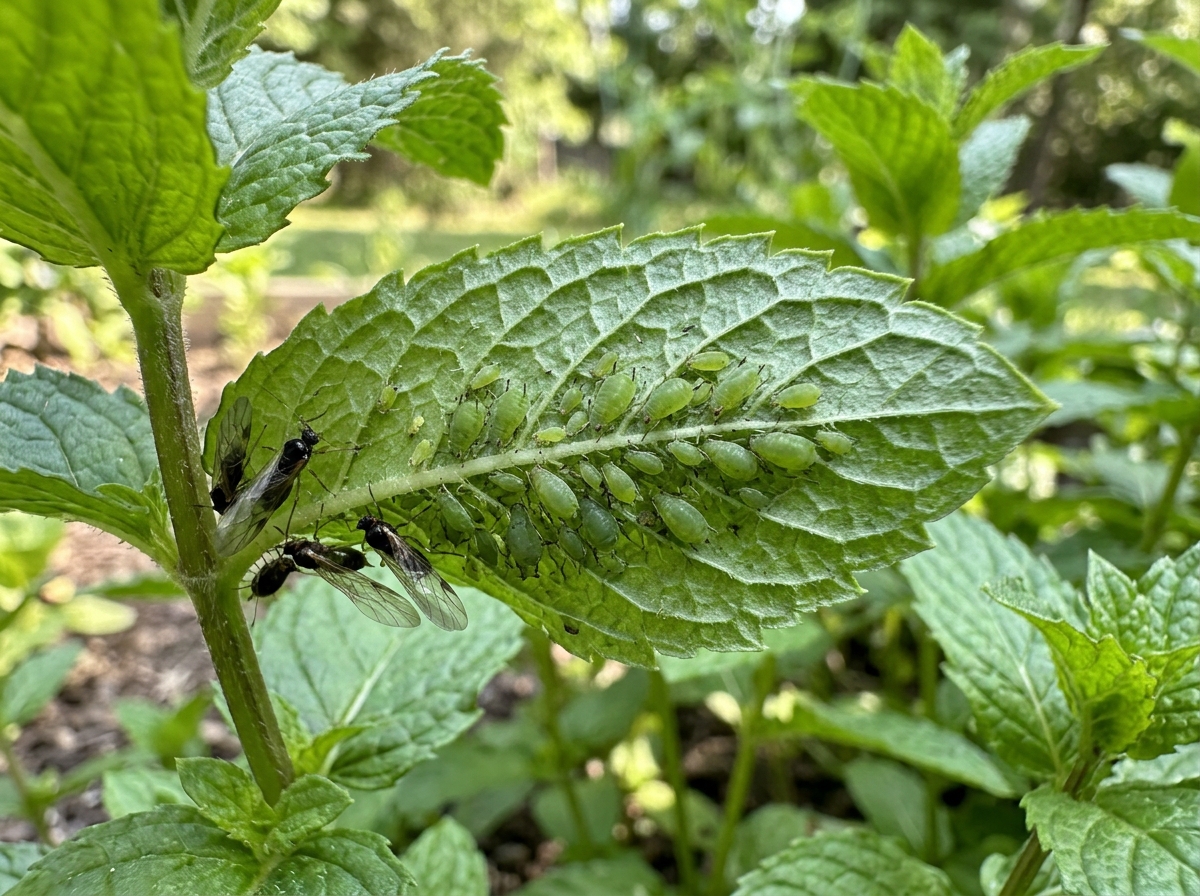
If you look closely—and we mean really closely, as wingless mint aphids are only about 1.5 to 2 mm in length—you’ll see small, soft-bodied insects. They are typically apple green to yellow-green in color. A key identifying feature of the mint aphid is that they often appear mottled with darker green markings.
While most of the aphids you see will be wingless, the population eventually produces winged forms. These “colonizers” have distinct dark brown to black heads and thorax areas, paired with yellow-green abdomens. These winged versions are the scouts; they are most common in the spring and fall, looking for new mint plants to conquer. If you’re seeing other types of pests, you might want to check out our guide on identifying the little black bugs eating your herbs to ensure you’re applying the right treatment.
Where Do They Hide?
Mint aphids are experts at hide-and-seek. They prefer the succulent stems and the protected undersides of leaves. They don’t just disappear when the weather gets cold, either. According to the Mint Aphid Life Cycle research, these pests overwinter as adults and nymphs. They hunker down around the bases of mint plants, on the roots (rhizomes), beneath plant debris, and even in tiny cracks in the soil. When spring arrives, the females begin giving birth to mobile nymphs, and the cycle starts all over again.
The Rapid Life Cycle of Aphids on Mint
Understanding the speed of an infestation is vital for stopping the sap suckers. These insects don’t waste time.
- Generational Speed: During the peak of summer and early fall, a mint aphid can complete an entire generation in just 7 to 10 days.
- Overlapping Generations: Because they reproduce so quickly, you can have 12 to 15 generations in a single year.
- Population Explosions: Since each female can produce dozens of offspring without needing a mate (a process called parthenogenesis), a dozen colonizers can turn into thousands of aphids in less than a month.
The summer heat acts like fuel for their development. As temperatures rise, so does their metabolic rate, leading to faster reproduction and denser colonies. This is why a mint patch that looked healthy on Monday can look like a disaster zone by the following Sunday.
Recognizing Damage from Aphids on Mint
How do you know you have aphids on mint before you actually see the bugs? Your plants will tell you.
- Yellowing and Curling: As aphids suck the nutrient-rich sap, the leaves lose their vitality. You’ll notice yellowing (chlorosis) and leaves that curl or twist unnaturally.
- Stunting: High populations drain so much energy that the stems become distorted and the entire plant’s growth is stunted.
- Sticky Residue (Honeydew): Aphids excrete a sugary waste product called honeydew. If your mint leaves feel sticky or look like they’ve been sprayed with sugar water, you have an infestation.
- Sooty Mold: That sticky honeydew is the perfect breeding ground for a fungus called sooty mold. This appears as a black, powdery coating on the leaves, which blocks sunlight and further weakens the plant.
- Water Stress: Because the aphids are draining the plant’s fluids, infested mint becomes much more susceptible to wilting and water stress, even if you are watering your herbs regularly.
Effective pest control for herb gardens starts with these early observations. If you catch them when the leaves just start to curl, the “eviction” process is much easier.
Natural and Organic Methods to Eliminate Pests
At Ponto de Arte, we believe that the best way to protect an aromatic herb garden is through methods that keep your harvest safe to eat. You don’t need to reach for heavy-duty industrial pesticides to clear out aphids on mint.
The High-Pressure Water Blast
The simplest “DIY” method is often the most effective. Aphids are soft-bodied and not particularly good at holding on. A strong stream of water from a garden hose can dislodge the majority of the colony.
- How to do it: Support the mint stems with one hand and spray the undersides of the leaves with a focused jet of water.
- Pro Tip: Do this in the morning so the plants have time to dry out, reducing the risk of fungal issues.
Organic Sprays and Solutions
If the water blast doesn’t do the trick, it’s time to look at DIY organic pesticides. These are excellent for natural pest control for beginners.
| Treatment Type | Ingredients/Ratio | How it Works |
|---|---|---|
| Insecticidal Soap | 1 tsp mild liquid soap per 1 quart water | Suffocates aphids on contact by breaking down their outer shell. |
| Alcohol Spray | 1 part 70% Isopropyl alcohol to 1 part water | Dehydrates and kills aphids instantly. |
| Neem Oil | Follow bottle instructions (usually 1-2 tbsp per gallon) | Acts as a repellent and disrupts the aphid’s hormonal system. |
| Cayenne Spray | 1 quart water, 1 tsp soap, pinch of cayenne | Adds a repellent “kick” to the soapy water. |
Important Note: Always test any spray on a small section of the plant first and wait 24 hours to ensure the leaves don’t burn. Apply these treatments in the evening or early morning to avoid “sun-scald” on the foliage.
Using Companion Plants to Repel Aphids on Mint
Nature has its own security system. By using companion planting for a thriving garden, you can make your mint patch much less attractive to pests.
- Repellent Plants: Alliums like garlic and chives are famous for their ability to confuse the “scent” of host plants. Planting these near your mint can act as a natural shield.
- Trap Cropping: Some plants are so irresistible to aphids that they can be used to lure them away from your precious herbs. Nasturtiums and mustard plants are excellent “sacrificial” crops. The aphids flock to the nasturtiums, leaving your mint alone.
- The Power of Catnip: Interestingly, catnip is often cited as a plant that can repel certain aphid species. Including it in your herb garden for pest control is a smart, aromatic strategy.
Encouraging Natural Predators in the Garden
Aphids have been called the “mice of the insect world” because so many other creatures eat them. If you can foster a balanced ecosystem, the “good bugs” will do the work for you. This is a cornerstone of natural pest control methods for organic gardening.
- Ladybugs: Both the adults and their larvae (which look like tiny black and orange alligators) are voracious aphid hunters.
- Lacewings: Often called “aphid lions,” their larvae can consume hundreds of aphids a week.
- Syrphid Flies: These flies look like tiny bees or wasps but don’t sting. Their larvae are effective aphid predators.
- Parasitic Wasps: These tiny wasps lay eggs inside aphids, killing them from the inside out.
To attract these helpers, plant “insectory plants” from the Daisy family (like marigolds or sunflowers) and the Carrot family (like dill or fennel). These provide the nectar and pollen that the adult predators need to survive between aphid snacks.
Is It Safe to Eat Mint with Aphids?
This is the number one question we get at Ponto de Arte. You’ve spent weeks growing mint at home, and you don’t want to throw it away just because a few bugs moved in.
The short answer is: Yes, it is safe.
In fact, the FDA considers aphids in certain frozen vegetables to be an “aesthetic” defect rather than a health hazard. If you’ve ever eaten frozen broccoli, there’s a statistical chance you’ve already consumed an aphid or two! However, for your fresh mint juleps or syrups, you probably want them gone.
How to Clean Harvested Mint
When harvesting herbs at home, follow these steps to ensure your mint is bug-free:
- The Initial Shake: Give the harvested stems a good shake outside to dislodge the larger insects.
- The Sink Rinse: Place the mint in a colander and use a high-pressure spray from your kitchen faucet.
- The Soak: Submerge the mint in a bowl of cool water with a splash of vinegar or a drop of dish soap for 5-10 minutes. The aphids will lose their grip and float to the surface.
- Inspection: Pat the leaves dry and do a final visual check.
Safe Consumption Methods
If you are making mint syrup, the boiling process will naturally sterilize the mixture. Any microscopic remnants are harmless. If you’re making mint juleps, some gardeners jokingly point out that the bourbon acts as a “sterilizing agent,” though a good wash is still recommended! For more details on this, you can check out the community discussion on can I still use mint if it has aphids?.
Advanced Control and Prevention Strategies
For those with larger mint patches or recurring issues, a more structured approach might be necessary. Professional growers often look at “economic thresholds”—treating only when the population reaches a certain level, such as 15 to 20 aphids per sweep of a net.
Biological and Botanical Boosts
If natural predators aren’t keeping up, you can introduce biological controls.
- Beauveria bassiana: This is a naturally occurring fungus that targets aphids and is best applied at the first sign of detection.
- Azadirachtin: An organic compound derived from neem seeds that is highly effective in commercial and home settings. According to the Pacific Northwest Pest Management Handbooks, these botanical options are preferred for maintaining organic care for healthy plants.
Cultural Prevention
Preventing aphids on mint is often about keeping the plant “stress-free.”
- Avoid Over-Fertilizing: Aphids love the tender, succulent growth produced by high-nitrogen fertilizers. Use a balanced organic soil for herbs to encourage steady, sturdy growth.
- Cleanliness: Since aphids overwinter in plant debris, clearing away old stems and leaves at the end of the season is crucial.
- Monitor Early: Check your mint at least once a week. It’s much easier to hand-squash ten aphids than it is to spray ten thousand.
Frequently Asked Questions about Aphids on Mint
How do I remove aphids from harvested mint leaves?
The best way is a three-step process: shake the stems vigorously outdoors, rinse them under a high-pressure kitchen tap, and then soak them in a bowl of cold water for 10 minutes. The aphids will float to the top, leaving your mint clean and ready for use.
Can aphids on mint spread to my indoor basil?
Yes, they certainly can. While the “mint aphid” prefers mint, many aphid species are generalists. If you have a kitchen windowsill herb garden, an infestation on one plant can quickly move to another. Check out our specific guide on aphids on basil indoors to prevent a total herb garden takeover.
Why does my mint have sticky black soot on the leaves?
That “soot” is actually sooty mold. It grows on the “honeydew” (sugary waste) that aphids excrete as they feed. To fix it, you must first get rid of the aphids. Once the pests are gone, the mold can usually be washed off with a damp cloth or will eventually disappear as the plant grows new leaves.
Conclusion
Dealing with aphids on mint can be frustrating, but it’s a manageable part of the gardening journey. By understanding their rapid life cycle and utilizing nature’s own defenses—like ladybugs and companion plants—you can keep your herb garden thriving and productive.
At Ponto de Arte, we are dedicated to providing specialized herb protection for your aromatic gardens. Whether you are managing an indoor herb garden or a sprawling outdoor mint patch, the key is early detection and gentle, organic intervention.
Ready to expand your herbal knowledge? Explore our guide to aromatic spices and herbs to learn more about keeping your garden healthy, vibrant, and pest-free!
