
When Leaf Miners Attack Your Dill: What You Need to Know
Leaf miners in dill are tiny fly larvae that tunnel through dill’s feathery leaves, leaving behind silvery, winding trails and blotchy patches that make your herb look — and sometimes taste — unpleasant.
Quick answer: How to control leaf miners in dill
- Remove damaged leaves immediately and dispose of them in the trash (not compost)
- Rub off egg clusters from the undersides of leaves with your finger
- Crush larvae by squeezing affected leaves between your fingers
- Apply neem oil to slow the spread organically
- Use floating row covers to stop adult flies from laying eggs
- Rotate your dill to a new garden spot each year to break the pest cycle
You might have walked out to your herb bed one morning to find your once-lush dill wilting and riddled with pale, squiggly lines — and wondered what went wrong. The damage looks almost artistic, but it’s actually the work of small fly larvae feeding inside your leaves.
The good news? Leaf miners rarely kill dill outright. The bad news? If you ignore them, they’ll spread fast, stunt your plant, and ruin your harvest.
This guide will show you exactly how to identify, stop, and prevent them — without reaching for harsh chemicals.
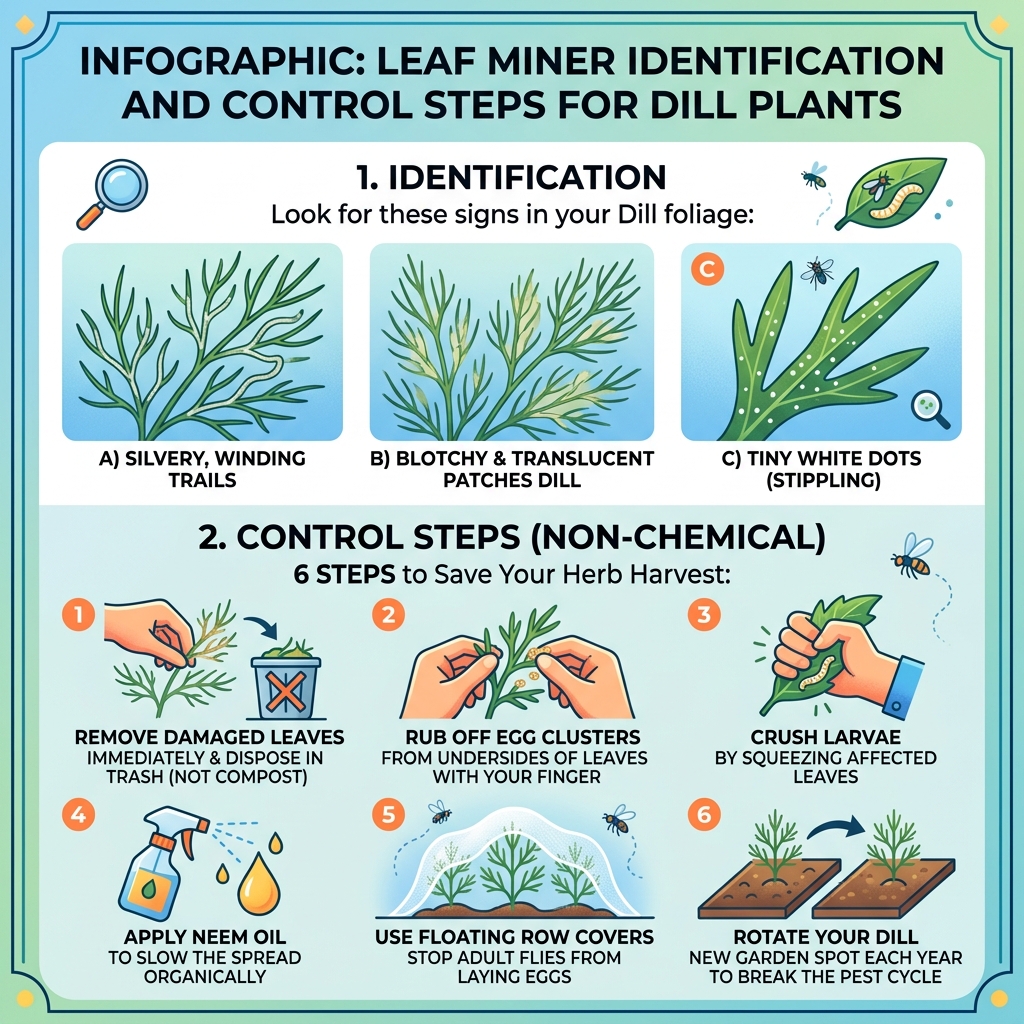
How to Identify and Manage Leaf Miners in Dill
Identifying leaf miners in dill is the first step toward saving your harvest. Unlike aphids or caterpillars that chew on the outside of the plant, leaf miners are “inside workers.” They are the larvae of tiny flies, primarily from the Agromyzidae family. These adult flies are about 1/15 to 1/10 of an inch long, often black with distinct yellow markings on their abdomen, looking somewhat like miniature fruit flies.
The damage starts when the female fly punctures the leaf surface to feed or lay eggs. This creates “stippling”—tiny white dots on the foliage. Once the eggs hatch, the real trouble begins. The larvae burrow into the mesophyll (the middle layer of the leaf) and begin eating their way through. Because dill has such fine, feathery foliage, the damage often appears as translucent patches or slightly wider “serpentine” tunnels compared to the broader blotches seen on spinach or beets.
According to the Leaf Miners | Illinois Extension guide, these pests are common in many vegetable gardens, but they can be particularly frustrating when they target aromatic herbs. If you see small black specks moving around your herb garden, you might want to check our guide on Identifying the Little Black Bugs Eating Your Herbs to see if you’re dealing with adult flies or another common pest.

Distinguishing Leaf Miners from Girdling Rodents
Sometimes, gardeners find their tall dill plants suddenly wilting or falling over and assume it’s a pest like the leaf miner. However, it is important to look at the base of the plant. If the stem is chewed all the way around or “girdled” near the soil line, you aren’t looking at insect damage—you likely have a rodent problem.
Voles and chipmunks are notorious for girdling the stems of tall herbs. While leaf miners cause foliage to look “silvery” or “mined,” they do not have the mouthparts to chew through a thick dill stem. If your dill looks beautiful at the top but is falling over, check for teeth marks at the bottom. For more help identifying these larger intruders, visit our resource on Pest Control for Herb Gardens.
| Feature | Leaf Miner Damage | Rodent Girdling (Voles/Chipmunks) |
|---|---|---|
| Location | Foliage and soft upper stems | Base of the stem near soil |
| Appearance | Squiggly lines, translucent blotches | Missing bark/tissue around the stem |
| Effect | Aesthetic damage, reduced vigor | Sudden wilting, plant death, falling over |
| Evidence | Larvae inside leaves, white dots | Teeth marks, burrows in soil |
Recognizing Early Symptoms on Dill Foliage
Early detection is the secret to organic success. We recommend scouting your dill plants at least once a week. Look for these specific signs:
- White Dots: Tiny, bleached-looking punctures on the leaf surface. These are oviposition scars where females have laid eggs or fed.
- Translucent Patches: Areas where the green chlorophyll has been eaten away, leaving only the “skin” of the leaf.
- Frass: If you look closely at a “mine,” you might see tiny black specks. That’s the larva’s waste, a clear sign of an active tenant.
- Wavy Lines: While dill’s thin leaves make tunnels harder to see than on a flat leaf like chard, you can still spot the pale, winding paths if you look closely.
As noted by the Leafminers on Vegetables | University of Maryland Extension, these symptoms can also serve as entry points for bacterial and fungal pathogens, so catching them early protects your plant’s overall health.
The Life Cycle of Leaf Miners in Your Herb Garden
To beat leaf miners in dill, we have to understand their timeline. These pests are experts at staying hidden. They typically overwinter as pupae in the top few inches of your garden soil. When the weather warms up in mid-spring (usually April or May), the adult flies emerge and begin their mission.
A single female can lay up to 250 eggs over her short lifespan. She tucks these tiny, white, rice-grain-shaped eggs (only about 0.04 inches long) onto the undersides of your dill leaves. Within 2 to 6 days, the eggs hatch, and the larvae immediately tunnel into the leaf. They spend about 2 to 3 weeks feeding through several “instars” (growth stages) before they are ready to pupate.
When they’ve had their fill, the larvae usually cut a hole in the leaf and drop to the soil to pupate, though some species may pupate right inside the leaf. In warm weather, the entire cycle from egg to adult can happen in less than 21 days! This means you can face multiple overlapping generations in a single growing season. For a broader look at managing these cycles, check out our guide on Natural Pest Control for Beginners.
Monitoring for Leaf Miner Eggs
The most effective “pesticide” is often your own thumb and forefinger. Because the eggs are laid on the underside of the leaves, they are protected from rain but visible to a keen eye.
We suggest checking the undersides of the first set of true leaves on young dill seedlings. If you see tiny white cylinders arranged in neat rows, you’ve found the eggs. You can simply rub them off with your finger to stop the infestation before it starts. This is also a great time to ensure your watering habits aren’t stressing the plants, as healthy plants are more resilient. You can find more on this in our Tips for Watering Herbs.
Organic Methods to Control Leaf Miners in Dill
If you already see tunnels, don’t panic! You can still save your dill. The first line of defense is manual removal. If only a few leaves are affected, pinch them off and put them in a sealed trash bag. Do not put them in your compost pile, as the larvae can survive and complete their life cycle there, returning to haunt you next year.
Another clever trick is the “squeeze” method. If you see a larva at the end of a tunnel (it will look like a tiny pale worm), simply squeeze that part of the leaf between your fingers to crush it. This stops the damage without losing the whole leaf.
Yellow sticky traps are also highly effective for catching the adult flies before they can lay eggs. Since the flies are attracted to the color yellow, hanging a few traps around your dill patch can significantly reduce the population. For more “kitchen-cupboard” solutions, read our article on DIY Organic Pesticides for Home Gardeners or explore Natural Pest Control Methods for Organic Gardening.
Organic Sprays for Leaf Miners in Dill
Sometimes an infestation gets ahead of us, and we need a little extra help. When choosing a spray for leaf miners in dill, we look for products with “translaminar activity.” This means the spray can penetrate the leaf surface to reach the larvae hiding inside.
- Neem Oil: This is a great organic choice. It works as an antifeedant and disrupts the hormone system of the larvae. While it might not kill them instantly, it slows the spread and makes the plant less attractive to adult flies.
- Spinosad: This is a more powerful organic option derived from soil bacteria. It is very effective against leaf miners, but use it sparingly and in the evening to avoid harming bees.
For more tips on using sprays safely around your herbs, see our Stop the Sap Suckers: A Guide to Aphid-Free Herbs.
Attracting Beneficial Insects and Parasitic Wasps
Nature has its own pest control department. Parasitic wasps, specifically those in the Diglyphus genus, are the natural enemies of leaf miners. These tiny wasps (which don’t sting humans!) lay their eggs inside the leaf miner larvae. When the wasp eggs hatch, they consume the leaf miner from the inside out.
To invite these “good guys” to your garden, you should plant a variety of flowering herbs and flowers nearby. Alyssum, yarrow, and even allowing some of your dill to go to flower will provide the nectar these wasps need. You can learn more about this in our list of the 10 Best Herbs for Pest Control to Save Your Garden.
Preventative Cultural Practices for Healthy Herbs
Prevention is always easier than a cure. By changing how we manage our garden space, we can make it much harder for leaf miners in dill to take hold.
One of the most important steps is garden sanitation. Many leaf miners also live on common weeds like lambsquarters, chickweed, and nightshade. By keeping your herb bed weed-free, you remove the “bridge” that allows pests to move onto your dill.
Crop rotation is another vital tool. Since leaf miners pupate in the soil, planting dill in the exact same spot year after year is like providing a buffet for the emerging flies. Move your dill to a different part of the garden each season to disrupt their cycle. For more foundational advice, check out our Organic Herb Gardening Tips and Best Herbs for Beginners.
Using Row Covers and Soil Tilling
Physical barriers are perhaps the most effective way to prevent leaf miners in dill. Floating row covers—lightweight, breathable fabrics—can be placed over your dill immediately after planting. This prevents the adult flies from ever reaching the leaves to lay eggs. Just make sure the edges are pinned down securely!
In the early spring, we also recommend lightly tilling or cultivating the top two inches of your soil. This can expose overwintering pupae to predators and the elements, significantly reducing the first wave of flies in April. These simple steps are part of what makes dill one of our Easy to Grow Culinary Herbs.
Harvesting and Using Dill After Pest Damage
If your dill has been hit by leaf miners, you might be tempted to pull the whole plant and throw it away. Don’t do it! While the damaged leaves might look a bit “unthrifty,” the plant is usually still productive.
Even if the leaves are wilted or have some tunnels, the flavor of the dill remains intact. As long as you aren’t seeing signs of secondary rot (mushy or foul-smelling areas), the herb is safe to use. For more on the best way to pick your herbs, see Harvesting Herbs at Home.
Making Pesto and Drying Damaged Dill
If the aesthetic damage is too much for a fresh garnish, consider processing the dill. Dill pesto is a fantastic way to use up large amounts of dill. The blending process makes the visual tunnels disappear, but the bright, tangy flavor remains.
Alternatively, you can dry your dill. Once dried and crumbled, the leaf miner damage is invisible, and you’ll have a great supply of homegrown seasoning for the winter. For more creative ways to use your harvest, browse our Organic Tips.
Frequently Asked Questions about Leaf Miners in Dill
Can I Eat Herbs Affected by Leaf Miners in Dill?
Yes! Leaf miner damage is purely aesthetic and does not make the herb toxic. However, heavily mined leaves can become tough or slightly bitter. We recommend simply cutting around the damaged parts or using the unaffected feathery bits for your cooking. If the leaf is mostly translucent and brown, it’s best to discard it as it will be unpalatable.
What are the Best Companion Plants to Deter Leaf Miners?
“Trap crops” are plants that leaf miners actually prefer over your dill. Planting Columbine, Lambsquarter, or Velvetleaf nearby can lure the pests away from your herbs. Conversely, planting strong-smelling companions like marigolds or alliums can sometimes confuse the flies, making it harder for them to find your dill.
When is the Best Time to Check for Infestations?
The best time to monitor is mid-morning, which is when female flies are most active in laying eggs. Start scouting in mid-April and continue weekly throughout the growing season. Early detection of those tiny white egg clusters on the leaf undersides is your best chance for a chemical-free garden.
Conclusion
Managing leaf miners in dill doesn’t have to be a battle. By using an Integrated Pest Management (IPM) approach—combining monitoring, physical barriers, and the help of beneficial insects—we can enjoy a bountiful herb harvest all season long. At Ponto de Arte, we believe that a healthy garden is a balanced one. With a little bit of vigilance and these organic strategies, your dill will stay lush, green, and ready for your next culinary masterpiece.
For more expert advice on leveling up your garden, explore our More herb gardening and spice tips. Happy gardening!
