
Spider Mites on Basil: What Every Herb Gardener Needs to Know
Spider mites on basil are one of the most frustrating pest problems you can face as a home herb gardener. These near-invisible invaders can turn a lush, fragrant plant into a sad, withered mess — often before you even realize something is wrong.
Quick answer: What are spider mites on basil?
- What they are: Tiny arachnids (related to spiders, not insects) that suck sap from basil leaves
- How to spot them: Yellow or bronze stippling on leaves, fine webbing on leaf undersides, tiny moving specks
- Why they spread fast: A single female can produce up to 20,000 descendants in just one month
- Best quick fix: Spray leaves (especially undersides) with a strong stream of water, then apply neem oil or insecticidal soap
- Are infested leaves safe to eat? Yes — rinse thoroughly before consuming
Basil and spider mites share an unfortunate common ground: they both love hot, dry conditions. That means the same sunny windowsill or summer garden bed that helps your basil thrive is also the perfect breeding ground for these pests.
The problem escalates quickly. Adults are only 1/50 of an inch long — nearly invisible to the naked eye. By the time you notice the damage, the population may already be in the hundreds or thousands.
This guide covers everything you need to identify, treat, and prevent spider mites on your basil — using safe, organic methods that won’t compromise your harvest.
Identifying the Invisible: What are Spider Mites?
To defeat your enemy, you must first understand them. Despite their name, spider mites are not true insects; they are microscopic arachnids, meaning they are more closely related to spiders, ticks, and scorpions. The most common culprit found on our beloved herbs is the two-spotted spider mite (Tetranychus urticae).
These pests are incredibly small, reaching only about 1/50 of an inch in length as adults. In the garden, you might see reddish-orange adults or pale green nymphs. Because they are so tiny, they often go unnoticed until they have established a massive colony. They live relatively short lives—averaging 21 to 28 days—but they make every second count by feeding voraciously on your plants.
What makes them particularly dangerous to your herb garden is how they feed. Spider mites use sharp, needle-like mouthparts to pierce individual plant cells and suck out the sap. According to scientific research on spider mite saliva, these pests actually inject proteins into the plant that suppress its natural immune response. This “cloaking” ability allows them to cause significant damage before the plant can try to defend itself. If you are growing basil indoors, the lack of natural wind and rain makes it even easier for these colonies to settle in.

The Microscopic Life Cycle
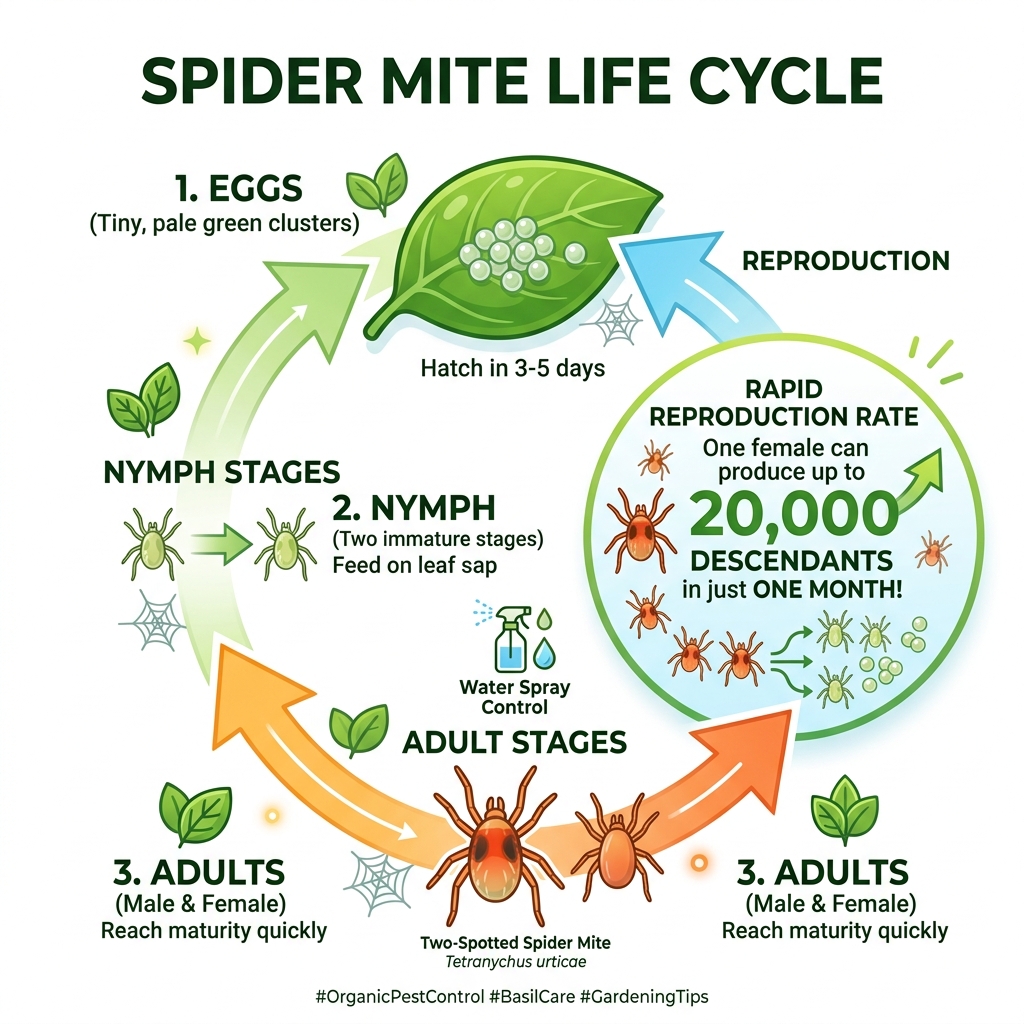
The speed at which spider mites on basil can take over a garden is nothing short of terrifying. Under optimal conditions—specifically warm, dry weather around 80°F (27°C)—a spider mite can complete its entire life cycle from egg to reproductive adult in under 7 days.
A single female can lay up to 100 eggs in her short lifetime, and those eggs can hatch in as little as 72 hours. When the math starts compounding, the results are staggering: a single female can lead to a population of 20,000 descendants in just one month. This is why a plant that looked healthy on Monday can look like it’s dying by Friday.
Recognizing the Signs of Spider Mites on Basil
Because the mites themselves are so hard to see, we usually have to look for the “fingerprints” they leave behind. The most common symptom is stippling—tiny, light-colored dots on the surface of the leaves where the mites have drained the chlorophyll.
As the infestation progresses, you’ll notice:
- Yellow or Bronze Spots: The leaves lose their vibrant green and begin to look washed out or “bronzed.”
- Leaf Curling: The edges of the leaves may begin to curl inward as the plant loses moisture.
- Withered Appearance: The overall plant loses vigor and looks dull.
- Webbing: In severe cases, you will see fine, silky webs spun between stems or on the undersides of leaves. This webbing protects the mites and their eggs from predators and environmental changes.
Recent studies on the physiological response of basil to mites show that different varieties react differently. For example, ‘Purpurascens’ (Purple Basil) tends to be slightly more resistant than the common ‘Fino Verde.’ Regardless of the variety, early detection is the only way to save your harvest. For more tips on what to look for, check out our guide on pest control for herb gardens.
Identifying Early Signs of Spider Mites on Basil
If you suspect you have uninvited guests, try the “White Paper Test.” Hold a sheet of plain white paper under a basil branch and give the foliage a firm shake. If you see tiny specks that look like dust but start to crawl around, you’ve found your spider mites.
Using a 10x magnifying glass can also help you spot the eggs and nymphs on the leaf undersides. Always check the lowest leaves first, as infestations often start near the base of the plant where it is shaded and protected.
Environmental Triggers for Infestation
Spider mites don’t just appear out of nowhere; they thrive when the environment is “just right” (for them, not the basil). The biggest triggers include:
- Low Humidity: Dry air is the #1 friend of the spider mite. This is why they are so common on indoor basil plants during the winter when the heater is running.
- Stagnant Air: Poor circulation allows the mites to settle and spin webs without being disturbed.
- Water Stress: A thirsty basil plant is a weak basil plant. Mites are more likely to successfully attack a plant that is already struggling with underwatering.
- Dust: Dust on leaves provides a perfect highway for mites to move around and can actually interfere with their natural predators.
Effective Organic Treatments for Spider Mites on Basil
When you find spider mites on basil, your first instinct might be to reach for a heavy-duty pesticide. Stop! Since you’ll likely be eating these leaves, you want to stick to organic methods. We always recommend starting with the least invasive method first.
| Treatment Method | How it Works | Best For |
|---|---|---|
| Water Spray | Physically knocks mites off | Early stages & prevention |
| Neem Oil | Disrupts growth & suffocates | Active infestations |
| Insecticidal Soap | Breaks down mite membranes | Stubborn colonies |
| Essential Oils | Repels and kills on contact | Long-term management |
The fastest organic fix is a strong blast of water. Take your basil to the sink or use a garden hose with a sprayer attachment. Focus the water pressure on the undersides of the leaves to dislodge the mites and wash away their webs. For more advanced strategies, see our natural pest control methods for organic gardening.
Using Essential Oils and Soaps
If water alone doesn’t do the trick, it’s time to bring in the organic “big guns.” Neem oil is a classic choice. It contains compounds that interfere with the mites’ ability to feed and reproduce. Interestingly, dried essential oil dilutions have been shown to remain active for up to 7 days after application.
You can make a DIY spray by mixing 20 drops of essential oil (like peppermint, tea tree, or rosemary) with 4 ounces of water. Always apply these treatments in the early morning or evening. Applying oil-based sprays in the heat of the midday sun can cause the sun to “cook” the leaves, leading to nasty burns.
Physical and Mineral Controls
For a more “gritty” approach, Diatomaceous Earth (DE) is a fossilized algae powder that acts like tiny shards of glass to the mites. It can kill them within 1 to 5 days by dehydrating their exoskeletons. However, use this as a last resort, as DE can also harm the “good bugs” in your garden, like honeybees and ladybugs.
If the infestation is localized, you can use a soft paintbrush to manually brush away webs and mites, or simply prune off the most heavily infested leaves using sterilized shears. If you’re feeling adventurous, you can even make your own DIY organic pesticides.
Long-Term Management and Prevention Strategies
Winning the battle is great, but winning the war is better. Long-term management of spider mites on basil requires changing the environment so they don’t want to live there in the first place.
In an outdoor garden, crop rotation is key. Don’t plant your basil in the exact same spot every year, as mites can overwinter in the soil and plant debris. Companion planting is another powerful tool; marigolds and garlic have strong odors that can help deter mites from moving in. Keeping your plants healthy is the best defense, so follow these organic care tips for healthy plants.
Preventing Spider Mites on Basil in Indoor Gardens
Indoor gardening presents a unique challenge because we control the “weather.” To keep mites away from your windowsill herbs:
- Gravel Trays: Place your pots on a tray filled with gravel and a shallow layer of water. As the water evaporates, it increases the humidity around the plant.
- Misting: Regularly mist your basil leaves (especially the undersides) with clean water.
- Airflow: Use a small fan to keep air moving, which prevents mites from establishing their silky “fortresses.”
Encouraging Natural Predators
In a healthy ecosystem, spider mites have plenty of enemies. Ladybugs, green lacewings, and specialized predatory mites (like Phytoseiulus persimilis) view spider mites as a delicious buffet. By avoiding broad-spectrum chemical pesticides, you allow these beneficial insects to do the hard work for you. You can even purchase predatory mites online to release directly onto your infested basil.
Frequently Asked Questions about Spider Mites
Can I still eat basil leaves that have had spider mites?
Yes! Spider mites are not toxic to humans. While the thought of eating tiny bugs isn’t pleasant, they won’t hurt you. If the leaves only have light stippling, they are perfectly safe to eat after a thorough rinsing in cold water. However, if the leaves are heavily bronzed, curled, or covered in thick webbing, the flavor may be bitter or “off,” and the texture will be unappealing. In those cases, it’s better to compost the leaves and wait for new growth.
Do spider mites lay eggs in the soil?
Generally, no. Spider mites prefer to stay on the plant where their food source is. However, they are famous for “overwintering.” Female mites will hide in plant debris, fallen leaves, or even tiny cracks in your garden stakes or pots during the cold months. This is why sanitation is so important—always clean up fallen leaves and sanitize your pots before reusing them.
How can I help my basil plant recover after an infestation?
Once the mites are gone, your basil needs some TLC.
- Prune: Cut back the damaged stems to encourage fresh, healthy growth.
- Fertilize: Give the plant a light boost of nitrogen-rich organic fertilizer or compost tea to help it rebuild its foliage.
- Hydrate: Ensure the plant stays consistently moist (but not waterlogged) to reduce stress.
- Soil Health: Amend the soil with fresh compost to provide the nutrients needed for a full recovery.
Conclusion
At Ponto de Arte, we know that your herb garden is more than just a hobby—it’s a source of fresh flavors and a peaceful retreat. Dealing with spider mites on basil can be a real buzzkill, but with a bit of vigilance and the right organic strategies, you can protect your aromatic plants and keep your harvest thriving.
By focusing on humidity, natural predators, and safe treatments like neem oil, you ensure that your basil remains healthy and chemical-free. The best defense is a good offense: keep your plants hydrated, your air moving, and your eyes peeled for those tiny moving specks.
Keep your kitchen windowsill herb garden thriving with our expert guides and never let a pest stand between you and the perfect homemade pesto again!
