
When Tiny Beetles Take a Big Bite Out of Your Lavender
Lavender flea beetle control is something every herb gardener needs to know — these small, jumping pests can riddle your lavender leaves with holes almost overnight.
Quick answer: How to control flea beetles on lavender
- Cover plants early with floating row covers before beetles arrive in spring
- Apply diatomaceous earth or kaolin clay directly to leaves
- Spray with neem-based insecticidal soap for active infestations
- Plant repellent companions like mint, sage, or catnip nearby
- Remove garden debris in autumn to eliminate overwintering sites
- Use trap crops like radishes or nasturtiums to lure beetles away
Flea beetles are tiny — only about 1/16 to 1/8 of an inch long — but don’t let their size fool you. A healthy lavender bed can go from lush to lace-like in just a day or two during peak beetle season.
They get their name from their powerful hind legs, which let them jump like fleas the moment you disturb them. They are not actual fleas, but the damage they leave behind is very real.
What’s especially frustrating for herb gardeners is that lavender — prized for its fragrance and beauty — is not immune. Gardeners have reported significant leaf damage on established lavender plants, even large ones in full sun. The good news? With the right approach, you can protect your plants without reaching for harsh chemicals.

Identifying Flea Beetles and Damage on Lavender
Before we can tackle lavender flea beetle control, we have to make sure we’re looking at the right culprit. If you walk out to your herb garden and see a cloud of tiny black specks jumping away as you brush past your lavender, you’ve likely found them.
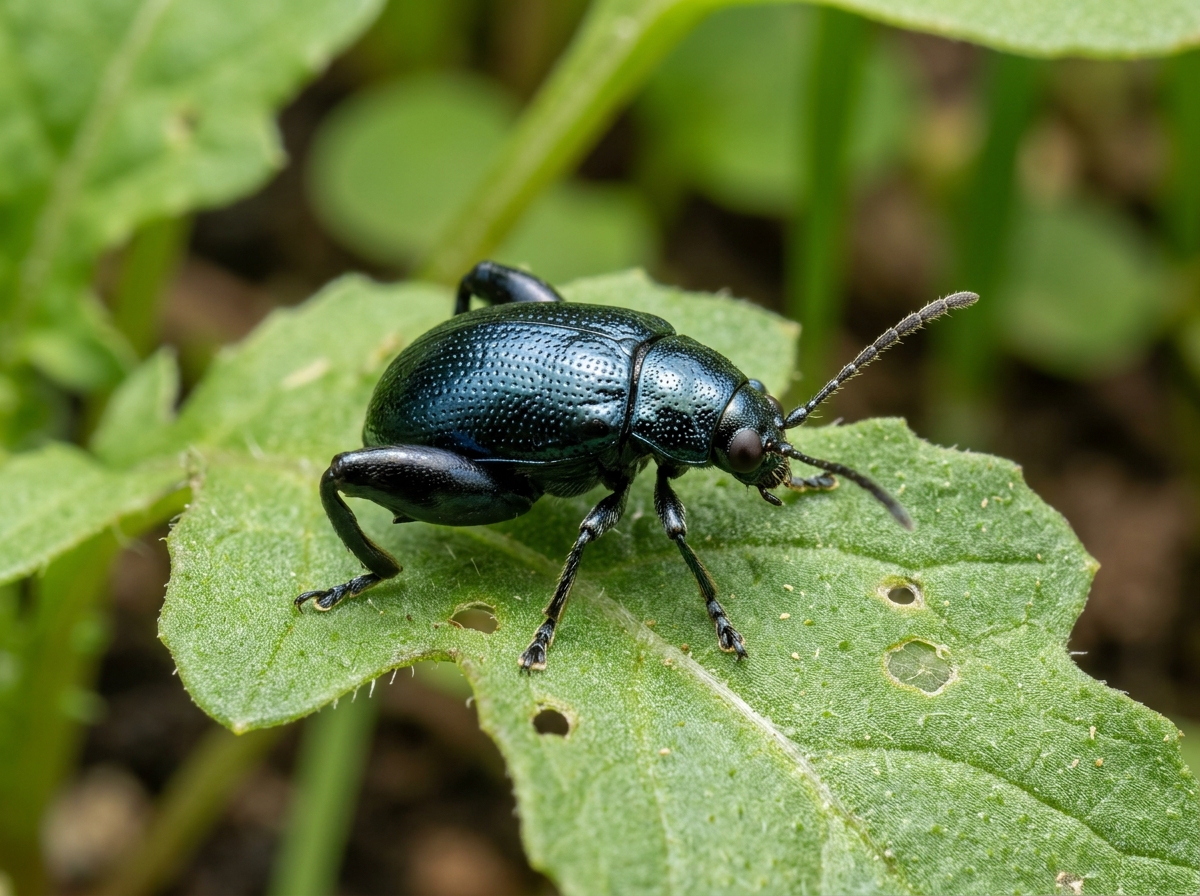
Flea beetles are incredibly small, usually measuring between 1/16 and 1/8 of an inch (about 1.5 to 3 mm). They typically have a shiny, hard shell that is black or bronze, though some species may have stripes. Their most defining physical trait isn’t their color, though—it’s their legs. They have enlarged hind legs that act like springs, allowing them to leap impressive distances relative to their size.
Recognizing the “Shot-Hole” Damage
The damage these pests cause is very distinctive. Instead of eating the edges of the leaves like a caterpillar might, flea beetles chew small, irregular holes right through the center of the leaf. This is often called “shot-hole” damage because it looks like the plant was hit by a tiny blast from a shotgun.
On thicker lavender leaves, you might see small divots or pits instead of complete holes. If left unchecked, these holes can merge, causing the leaf to turn yellow or brown and eventually drop off. For young lavender starts, this can be fatal. For mature plants, it stunts growth and ruins the aesthetic of your aromatic garden. If you’re seeing these signs, it’s time to check out our guide on identifying the little black bugs eating your herbs.
Distinguishing Flea Beetles from Garden Fleahoppers
Sometimes, we find ourselves blaming flea beetles for the work of an imposter: the garden fleahopper. While they both jump and are roughly the same size, they are different pests that require slightly different management.
According to research from onspecialtycrops, the easiest way to tell them apart is by looking at their antennae. Flea beetles have relatively short antennae. Garden fleahoppers, on the other hand, have antennae that are often longer than their entire bodies.
Furthermore, the damage differs slightly. While flea beetles chew holes (shot-holes), fleahoppers are “true bugs” (Hemiptera) that suck sap. Their feeding causes “stippling” or white flecking on the leaves. If your lavender leaves look like they have tiny white dots rather than actual holes, you might be dealing with fleahoppers. However, both pests are often found together, especially on Lavandula angustifolia cultivars.
The Lifecycle: When is Your Lavender Most Vulnerable?
Understanding the rhythm of a flea beetle’s life is the secret weapon in our lavender flea beetle control arsenal. These pests don’t just appear out of thin air; they follow a predictable seasonal pattern.
- Overwintering: Adult flea beetles spend the winter hiding in garden debris, tall grass, or under leaf mulch. They are patient survivors, waiting for the first signs of warmth.
- Spring Emergence: Once temperatures consistently reach about 50°F (10°C), the adults wake up. This is usually when your lavender is putting out its most tender, delicious new growth.
- Egg Laying and Larvae: Females lay tiny, 0.4mm elliptical eggs in the soil at the base of your plants. About a week later, the larvae emerge. These larvae live underground for two to three weeks, feeding on fine root hairs. While this usually doesn’t kill established lavender, it can weaken young seedlings.
- Pupation and New Adults: The larvae pupate in the soil and emerge as a fresh generation of adults in another two to three weeks.
We typically see two generations per growing season. The most critical time for control is early spring. This is when the beetle population is high and your lavender is at its most vulnerable. As plants mature and the weather gets hotter in mid-summer, they can often withstand a bit of nibbling more easily. For those just starting their journey in pest management, we recommend reading up on natural pest control for beginners 2 to get a handle on these cycles.
Cultural Strategies for Lavender Flea Beetle Control
We always prefer to start with “cultural” controls—which is just a fancy way of saying “how we manage the garden.” These methods focus on making your garden less attractive to pests in the first place.
Garden Hygiene and Sanitation
Since flea beetles overwinter in garden trash, the best thing we can do in the autumn is a deep clean. Remove old plant debris, pull weeds that might serve as alternate hosts, and clear out thick layers of wood mulch where they might hide. By removing their “winter blankets,” we significantly reduce the number of adults that survive to attack our lavender in the spring.
Strategic Planting and Row Covers
Timing is everything. If you are transplanting new lavender, consider waiting until the weather is consistently warm. This allows the plants to grow rapidly and outpace the damage.
One of the most effective physical barriers we use is the floating row cover. This is a lightweight, translucent fabric that you drape over your plants. It allows light and water in but keeps the jumping beetles out. You must secure the edges tightly with soil or pins, as these beetles are experts at finding gaps. For more on this, check out our tips on pest control for herb gardens.
Using Trap Crops to Protect Your Herbs
A trap crop is a “sacrificial” plant that flea beetles love even more than lavender. By planting these nearby, we lure the beetles away from our precious herbs.
- Radishes: These are the gold standard for flea beetle traps. They grow fast and beetles find them irresistible.
- Nasturtiums: These beautiful flowers are also a favorite of the beetle.
- Mustard Greens: These are highly attractive to the crucifer flea beetle.
The trick is to plant the trap crop about 7–10 days before your lavender starts its spring growth. Once the trap crop is covered in beetles, you can physically remove the beetles (using a hand vacuum is a popular, if slightly funny, method!) or treat the trap crop specifically, leaving your lavender untouched.
Best Companion Plants for Lavender Flea Beetle Control
Nature provides its own repellents. Some plants produce scents that confuse or deter flea beetles. We love interplanting lavender with these helpful neighbors:
- Mint and Catnip: These have strong aromatic oils that flea beetles dislike. (Pro tip: grow mint in a container so it doesn’t take over your garden!)
- Sage: Compounds in sage can actually disrupt the beetle’s sensory receptors.
- Bunching Onions or Chives: The onion scent is a great general deterrent.
For a deeper dive into this natural strategy, see our list of the 10 best herbs for pest control to save your garden.
Organic and Chemical Lavender Flea Beetle Control Methods
If the beetles have already arrived and are making a meal of your lavender, it’s time for more direct action. We always recommend starting with the gentlest organic methods before moving to stronger solutions.
Diatomaceous Earth and Kaolin Clay
These are “mechanical” controls. Diatomaceous Earth (DE) is made from the fossilized remains of tiny aquatic organisms. To us, it feels like soft powder; to a flea beetle, it’s like walking over broken glass. It scuffs their exoskeletons, causing them to dehydrate and die. Dust it liberally over the leaves and the soil at the base of the plant. Note: You’ll need to reapply after rain.
Kaolin clay works differently. When mixed with water and sprayed on leaves, it leaves a powdery white film. This film confuses the beetles—they don’t recognize the plant as food, and the texture is unpleasant for them to land on.
Insecticidal Soaps and Neem Oil
For a more active spray, we use insecticidal soap. You can even make a DIY version using one tablespoon of Castile soap per quart of water. This works on contact by breaking down the beetle’s outer shell.
Neem oil is another fantastic organic option. It acts as both a repellent and a growth disruptor. When the beetles ingest it, it interferes with their ability to feed and reproduce. For more DIY recipes, check out diy-organic-pesticides-for-home-gardeners.
Natural Predators and Biological Controls
We can also recruit “tiny soldiers” to help us.
- Beneficial Nematodes: These are microscopic worms you add to the soil. They hunt down flea beetle larvae and pupae, stopping the next generation before it can fly.
- Braconid Wasps: These tiny, non-stinging wasps lay their eggs inside adult flea beetles.
- Lacewings: Known as “aphid lions,” these generalist predators will also snack on flea beetles.
To attract these helpers, plant “umbrella-type” flowers like dill, cilantro, or sweet alyssum around your garden borders. You can learn more about managing these helpful insects in our guide on how to stop the sap-suckers.
When to Use Pesticides for Lavender Flea Beetle Control
Sometimes, despite our best efforts, an infestation becomes severe. If you are losing more than 10-15% of your plant’s foliage, you might consider organic-approved pesticides like Spinosad or Pyrethrin.
- Spinosad: Derived from a soil bacterium, it is very effective against beetles but should be used sparingly to protect bees.
- Pyrethrin: Extracted from chrysanthemum flowers, it provides a quick “knockdown” of adult beetles.
Always apply these in the late evening when bees are not active, and follow the label instructions exactly. As mentioned in the PlantVillage forum, persistence is key. One spray is rarely enough; you often need to treat the plants every few days until the “wave” of beetles passes.
Frequently Asked Questions about Flea Beetles
Can flea beetles kill mature lavender plants?
While they rarely kill a large, established lavender plant, they can severely weaken it. The real danger is to young seedlings and transplants. However, flea beetles can also transmit diseases like blight and wilt, which can kill even mature plants. This is why lavender flea beetle control is important even if your plants are old.
How often should I apply diatomaceous earth?
You should apply DE whenever you see active beetles. However, it loses its effectiveness when wet. You must reapply after every rainstorm or heavy dew. For the best results, apply it in the early morning when there is just enough moisture for the powder to stick to the leaves, but not so much that it clumps.
Do yellow sticky traps work for flea beetles?
Yes, they do! Flea beetles are attracted to the color yellow. While sticky traps might not eliminate a massive infestation, they are excellent for monitoring. If you see beetles appearing on your traps, you know it’s time to start your other control methods.
Conclusion
At Ponto de Arte, we know that your lavender is more than just a plant—it’s the heart of your aromatic garden. Dealing with flea beetles can be frustrating, but it doesn’t have to be a losing battle. By combining good garden hygiene, physical barriers like row covers, and organic treatments like neem oil, you can keep your herbs healthy and hole-free.
The goal of integrated pest management isn’t necessarily to kill every single bug, but to create a balanced ecosystem where your plants can thrive. Stay diligent, keep an eye on those “shot-holes,” and don’t be afraid to use a vacuum if things get jumpy!
For more specialized advice on keeping your herb garden pristine, explore our full range of herb garden solutions.
