
Your Herb Garden Deserves Better Than Bugs
The best organic sprays for herbs keep your plants healthy and your harvests safe — without harsh chemicals that can harm your family, your bees, or the flavor of your favorite basil and mint.
Here are the top options at a glance:
| Organic Spray | Best For | Key Active Ingredient |
|---|---|---|
| Neem oil | Aphids, whiteflies, spider mites | Azadirachtin |
| Insecticidal soap | Soft-bodied insects | Potassium salts of fatty acids |
| Bt | Caterpillars, cabbageworms | Bt protein |
| Spinosad | Leaf-chewing insects | Spinosad |
| Botanical oil sprays | Broad-spectrum insects + fungal disease | Thyme, rosemary, clove, peppermint oils |
| DIY garlic or hot pepper spray | Repelling pests | Diallyl disulfide, capsaicin |
You put real care into growing your herbs. The smell of fresh rosemary, the satisfaction of snipping basil straight into dinner — it’s one of gardening’s best rewards.
Then the pests show up.
Aphids cluster on new growth. Whiteflies hover in clouds. Tiny spider mites turn leaves dull and spotty. It’s frustrating — especially when you don’t want to reach for something toxic on plants you’re going to eat.
That’s exactly why organic sprays matter for herb gardens. Unlike synthetic pesticides, the best organic options are safe to use on edibles, gentler on beneficial insects like bees and ladybugs, and effective enough to actually solve the problem.
According to large-scale gardener surveys, insecticidal soap has a 90% effectiveness rate against whiteflies, while Bt reaches a 95% effectiveness rate against cabbageworms. These aren’t weak alternatives — they genuinely work.
This guide covers everything you need: which sprays target which pests, DIY recipes you can make today, and how to apply them safely without harming your garden’s good guys.
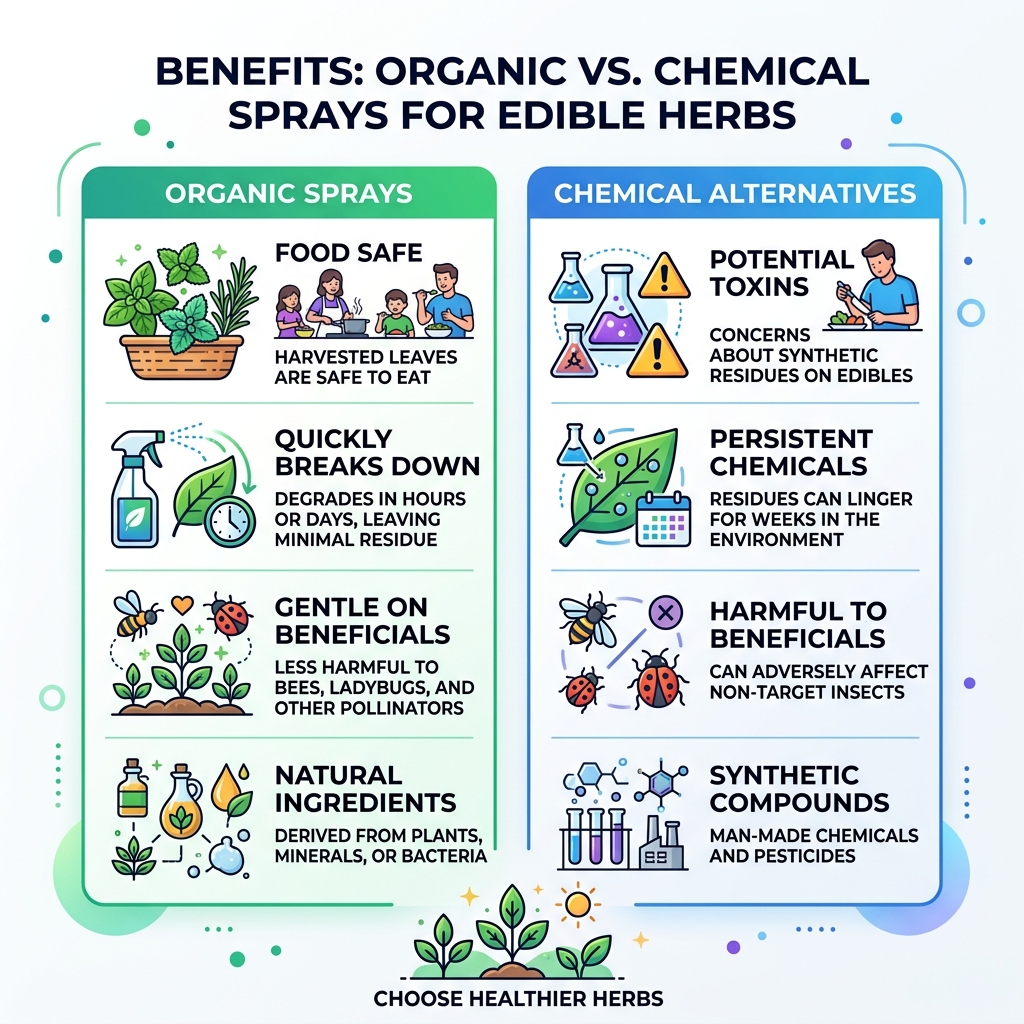
Why Organic Sprays are the Best Choice for Your Herb Garden
When we talk about herbs, we aren’t just talking about landscaping; we are talking about ingredients. Whether you are brewing a soothing peppermint tea or garnishing a Caprese salad with fresh basil, those leaves are going directly into your body. This makes the choice of pest control a matter of food safety.
The best organic sprays for herbs offer a chemical-free approach that aligns with the philosophy of sustainable cultivation. Synthetic pesticides often leave behind residues that can persist for weeks. In contrast, most organic sprays break down quickly in the environment, often within hours or a few days. This is crucial for herbs, which are frequently harvested in small amounts throughout the season.
Furthermore, we must consider our “garden allies.” Did you know that only about 3% of the insects in our gardens are actually harmful? That means 97% of the bugs you see are either beneficial or neutral. Ladybugs, lacewings, and syrphid flies (whose larvae can eat up to 100 aphids per week!) are your best friends. Organic sprays, when used correctly, are far less likely to cause a long-term “biological desert” in your garden.
For those just starting out, we recommend checking out this guide on natural pest control for beginners to understand the basics of balance. By choosing organic, you are protecting the pollinators that make our gardens thrive. If you want to dive deeper into the methodology, our resource on natural pest control methods for organic gardening explains how these sprays fit into a larger, holistic system.
Identifying Common Pests and the Best Organic Sprays for Herbs to Combat Them
Before you start spraying, you need to know who you’re fighting. In aromatic herbs, we generally deal with a few usual suspects. Identifying them correctly ensures you don’t waste time or product on the wrong solution.
- Aphids: These are the classic “sap-suckers.” They are tiny, pear-shaped insects that cluster on the tender new growth of mint, dill, and parsley. They can cause leaves to curl and turn yellow. For a deep dive into managing these, see our guide to aphid-free herbs.
- Whiteflies: If you brush against your rosemary and a cloud of tiny white “moths” flutters up, you have whiteflies. They suck plant juices and excrete a sticky substance called honeydew.
- Spider Mites: These are nearly invisible to the naked eye, but you’ll notice their fine webbing or the “stippling” (tiny yellow dots) they leave on leaves.
- Caterpillars: From the cabbage looper to the parsley worm, these “leaf-munchers” can strip a plant overnight. If you see large holes or dark green droppings (frass), you have caterpillars.
To help you choose, we’ve put together this comparison table:
| Pest | Identifying Feature | Best Organic Active Ingredient |
|---|---|---|
| Aphids | Clusters on stems/under leaves | Neem oil, Insecticidal soap |
| Whiteflies | Tiny white clouds when disturbed | Insecticidal soap (90% effective) |
| Spider Mites | Fine webbing, leaf stippling | Horticultural oil, Neem oil |
| Caterpillars | Holes in leaves, frass | Bt (95% effective), Spinosad |
| Slugs | Slime trails, ragged edges | Diatomaceous earth (84% success) |
If you aren’t sure what you’re looking at, don’t worry—identifying those little black bugs eating your herbs is the first step toward a solution.
Using Neem Oil as one of the Best Organic Sprays for Herbs
Neem oil is often called the “Swiss Army Knife” of organic gardening. Derived from the seeds of the neem tree, its primary active ingredient is azadirachtin. This compound works in a fascinating way: it doesn’t always kill on contact. Instead, it mimics the hormones of insects, interfering with their ability to feed, grow, and reproduce.
It is particularly effective against soft-bodied insects. Interestingly, 79% of gardeners found that spraying neem on egg clusters and juvenile squash bugs was significantly helpful. Neem also acts as a mild fungicide and miticide, making it a great choice for herbs like sage or monarda that are prone to powdery mildew. When looking for the best organic sprays for herbs, ensure you choose 100% cold-pressed neem oil rather than “neem extracts,” which may have had the azadirachtin removed.
Microbial Solutions: Bt and Spinosad as the Best Organic Sprays for Herbs
Sometimes, the best way to fight nature is with nature. Microbial sprays use specific bacteria or their byproducts to target pests.
- **Bt:** This is a soil-dwelling bacterium that is incredibly specific. It only affects the digestive systems of caterpillars. When a cabbageworm eats a leaf sprayed with Bt, it stops feeding almost immediately and dies within a few days. It has a staggering 95% effectiveness rating against imported cabbageworms. It’s perfect for protecting your kale, parsley, and dill without harming bees or humans.
- Spinosad: This is another fermented byproduct of a soil bacterium. It is a bit broader in its reach than Bt, making it one of the best organic sprays for herbs dealing with thrips, leafminers, and certain beetles. It holds a 79% effectiveness rating against cabbageworms and is a powerhouse for leaf-chewing pests.
Top Homemade Recipes for Natural Herb Protection

If you have a pest emergency and can’t get to the store, your kitchen is a goldmine. Many of the best organic sprays for herbs can be whipped up using everyday household items. Homemade sprays are cost-effective and allow you to control exactly what goes onto your plants.
Before you start mixing, remember a few rules: always use a mild, biodegradable soap (like Castile soap) rather than harsh detergents with degreasers. Also, always test your concoction on a single leaf and wait 24 hours to ensure it doesn’t burn the plant.
For those looking for specific herb-based solutions, you might want to explore how to find the perfect kitchen mint bug spray for your garden, which utilizes the natural repellent properties of mint itself.
Effective DIY Soap and Oil Formulations
The science behind soap and oil sprays is simple: they work by physical action. Soap disrupts the cell membranes of soft-bodied insects, while oil smothers them by blocking their breathing pores (spiracles).
The Basic Soap Spray:
- Recipe: Mix 1 tablespoon of mild liquid soap (like Dr. Bronner’s) into 1 quart of water.
- Target: Aphids, whiteflies, and thrips.
- Pro Tip: Use soft water if possible, as minerals in hard water can prevent the soap from emulsifying properly.
The “Supercharged” Oil Spray:
- Recipe: Mix 1 cup of vegetable oil with 1 tablespoon of mild liquid soap. This is your “concentrate.” When you are ready to spray, add 2 to 8 teaspoons of this mixture to 1 quart of water.
- Target: Mites, scale, and aphid eggs.
- Why it works: The soap acts as an emulsifier, allowing the oil and water to mix so you can spray it evenly.
Garlic and Pepper Repellent: While statistics show that garlic-pepper sprays can have disappointing failure rates (sometimes exceeding 30%) for heavy infestations of cabbageworms, they are excellent repellents.
- Recipe: Puree 2 bulbs of garlic and 1 tablespoon of cayenne pepper with a small amount of water. Let it sit overnight, strain it through a cheesecloth, and mix it with a gallon of water and a teaspoon of soap.
- Target: Deterring Japanese beetles and mammals from nibbling your herbs.
For more detailed recipes, check out our guide on DIY organic pesticides for home gardeners.
Safe Application and Non-Spray Alternatives
Even the best organic sprays for herbs should be used as a last resort. At Ponto de Arte, we believe in a “prevention first” philosophy. Before you grab the spray bottle, consider these non-toxic barriers:
- Row Covers: These are lightweight fabrics that let in light and water but block insects. They are 93% effective at blocking cutworms and can stop flea beetles in their tracks. See our guide on netting your way to flea beetle freedom for more.
- Handpicking: It’s not glamorous, but handpicking slugs has an 87% success rate. For tomato hornworms or large beetles, a pair of tweezers and a bucket of soapy water are your most precise tools.
- Beneficial Habitats: 81% of gardeners find that providing a habitat for beneficial insects (like planting flowers near your herbs) helps reduce pest problems.
Maximizing Results with the Best Organic Sprays for Herbs
If you must spray, do it right. Poor application is the number one reason organic treatments “fail.”
- Timing is Everything: Never spray in the heat of the day or in direct sunlight. This can cause “phytotoxicity” (leaf burn). The best time is in the early evening. This also protects bees, who are most active during the day.
- Hit the Undersides: Most pests, especially aphids and mites, hide on the undersides of leaves. If you only spray the tops, you’re missing the party.
- Consistency: Organic sprays often need to be reapplied every 5 to 7 days, or after a heavy rain, because they break down so quickly.
- Temperature Matters: Avoid spraying when temperatures exceed 90°F.
To learn more about the nuances of protecting your specific plants, read our article on pest control for herb gardens. You might even find that planting certain “sacrificial” or repellent plants can do the work for you—check out the 10 best herbs for pest control to save your garden.
Frequently Asked Questions about Herb Pest Control
Can I spray organic pesticides on herbs the day of harvest?
Many commercial organic sprays, like those based on thyme oil or citric acid, have a “0-day Pre-Harvest Interval” (PHI). This means you can spray and harvest on the same day. However, we always recommend washing your herbs thoroughly in cool water before eating to remove any oily residues or soap tastes. For neem oil or spinosad, we generally suggest waiting at least 1-3 days for the best flavor.
Will organic sprays harm bees and ladybugs in my garden?
They can. “Organic” does not always mean “safe for all bugs.” For example, Spinosad is toxic to bees if they are sprayed directly or if they touch the wet residue. To protect our pollinator friends, always spray in the late evening when bees have returned to their hives. Once the spray has dried, it is generally much safer.
How often should I reapply homemade herb sprays for maximum effect?
Because homemade sprays lack the stabilizers found in commercial products, they break down very fast. For an active infestation, we recommend reapplying every 4 to 5 days for at least two weeks. This ensures you catch the new generation of insects as they hatch from eggs that the spray might have missed.
Conclusion
At Ponto de Arte, we know that your herb garden is a labor of love. Choosing the best organic sprays for herbs is about more than just killing bugs—it’s about fostering a healthy, vibrant ecosystem where you can harvest with confidence.
By using a combination of Integrated Pest Management (IPM), physical barriers, and targeted organic treatments like Bt or neem oil, you can keep the “sap-suckers” at bay while keeping your kitchen stocked with aromatic, chemical-free greens. Remember: a few nibbled leaves are often a sign of a healthy, pesticide-free garden, but when the pests get out of hand, you now have the tools to fight back naturally.
Ready to take your herb garden to the next level? Protect your aromatic herb garden today with our specialized solutions and expert advice. Happy gardening!
