
When Your Mint Looks Sick: What to Do Right Now
A kitchen mint fungal cure is something every windowsill herb gardener needs at some point. Mint is tough, but it isn’t invincible — and fungal diseases like powdery mildew and rust can turn a thriving plant into a sad, spotted mess faster than you’d expect.
Here’s a quick answer if you need it now:
| Problem | Quick Kitchen Cure | How to Apply |
|---|---|---|
| Powdery mildew | Baking soda spray | 1 tbsp baking soda + ½ tsp liquid soap per gallon of water |
| Mint rust | Remove infected leaves + heat treat roots | Immerse rhizomes in 44°C water for 10 minutes |
| Fungal leaf spots | Diluted mint essential oil spray | A few drops in water, sprayed on affected leaves |
| Recurring fungus | Improve airflow + reduce moisture | Space pots, water at the base only |
Fungal spores are basically everywhere. They’re just waiting for the right conditions — dampness, poor airflow, overcrowded pots — to take hold. On a kitchen windowsill, those conditions can sneak up on you quickly.
The good news? Most mint fungal problems can be treated naturally, without harsh chemicals, using things you likely already have at home. And because mint is something you eat, that matters a lot.
This guide walks you through exactly what to do, step by step.
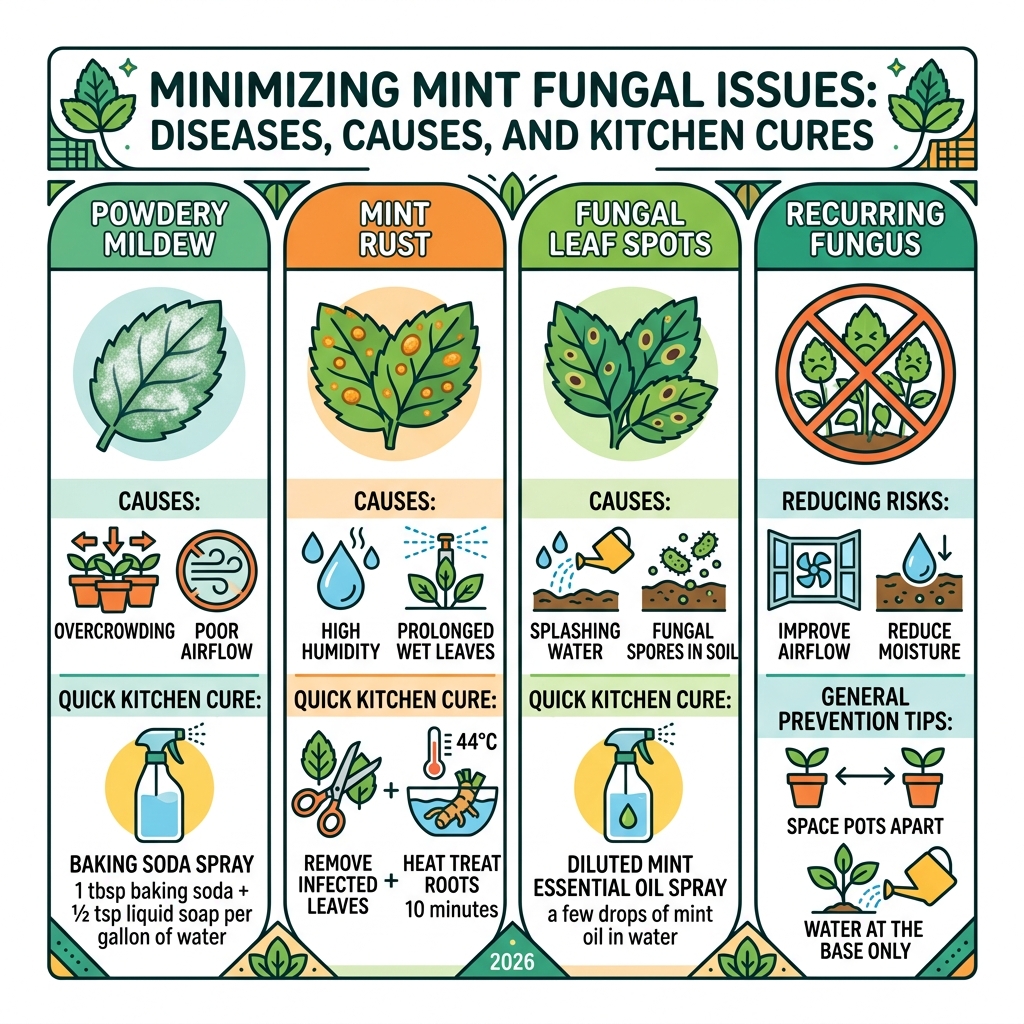
Identifying Common Fungi on Your Kitchen Mint

Before we can apply a kitchen mint fungal cure, we need to know exactly what we are fighting. Think of this as “plant triage.” If you don’t know the enemy, you can’t choose the right weapon. In our experience at Pontodearte, most windowsill mint problems fall into a few specific categories.
Powdery Mildew: The Flour Fight
If your mint looks like it has been in a flour fight, you are likely dealing with powdery mildew. This is caused by the fungus Erysiphe cichoracearum. It starts as small white spots that eventually cover the entire leaf in a dusty, white film. This film isn’t just an aesthetic issue; it blocks the leaf from performing photosynthesis, essentially starving your plant. You can learn more about managing these basics in our guide on growing-mint-at-home.
Mint Rust: The Orange Intruder
Mint rust, caused by the fungus Puccinia menthae, is a bit more devious. It shows up as dusty orange, yellow, or even black pustules on the undersides of leaves. You might also notice that the new shoots in the spring look pale and distorted. This is a common problem for garden mint but can easily hitch a ride into your kitchen. For detailed identification, the Mint Rust: Causes & Treatment guide is an excellent resource.
Black Spot and Leaf Wilt
If you see large black or dark brown spots on the leaves, your mint might be suffering from black spot or a specific type of leaf spot. These are often caused by poor air circulation or water sitting on the leaves for too long. If the stems are turning mushy or the whole plant is drooping despite having wet soil, you may be looking at root or stolon rot, often caused by Rhizoctonia solani.
Identifying these early is key. Fungal spores are microscopic opportunists, and once they’ve rolled out the red carpet, they move fast. Keep your peepers peeled for any discoloration or “fuzz” that shouldn’t be there!
The Science Behind a Kitchen Mint Fungal Cure
It might sound strange to use mint to cure mint, but the science is fascinating. Research into Mentha arvensis (Wild Mint) and Mentha piperita (Peppermint) has revealed that these plants are packed with natural antifungal powerhouses.
Active Compounds: Menthol and Menthone
The primary reason mint works as a kitchen mint fungal cure is its essential oil content. The main active compounds are menthol and menthone. These aren’t just for making your breath smell fresh; they are the plant’s natural defense system. Scientific studies have shown that these compounds can inhibit a wide range of fungi, including Candida albicans, Aspergillus niger, and Aspergillus flavus.
Antitoxigenic Effects and Toxin Reduction
One of the most impressive findings in recent years is how mint extract affects mycotoxins. A study on the Effect of mint extracts on citrinin production showed that mint extract could inhibit the production of citrinin (a harmful toxin produced by Penicillium citrinum) by up to 73%.
What’s even more interesting is that the extract achieved this 73% toxin reduction without necessarily killing the fungus itself. It essentially “turned off” the fungus’s ability to produce poison. This makes mint a fantastic candidate for a safe, natural remedy in a kitchen-windowsill-herb-garden where food safety is the top priority.
How to Prepare and Apply a Kitchen Mint Fungal Cure
Now that we know the “why,” let’s get into the “how.” Preparing a kitchen mint fungal cure can be done in two main ways: using an aqueous (water-based) extract or using diluted essential oils.
The Aqueous Extraction Method (The Maceration Process)
If you have a healthy patch of mint and want to use it to protect other plants, you can create a simple water-based extract.
- Take about 10g of fresh mint leaves.
- Macerate (crush) them thoroughly.
- Mix with 100mL of sterilized or distilled water.
- Let it sit for 24 hours to allow the active compounds to leach into the water.
- Filter the liquid through a coffee filter or fine cheesecloth.
Research suggests that a concentration of around 0.84 mg/mL is highly effective for inhibiting toxin production. While it’s hard to measure milligrams exactly in a kitchen, a strong “tea” made from crushed leaves is a great starting point.
The Essential Oil Dilution Method
For a more concentrated punch, you can use Peppermint essential oil. This is often more effective against tough cookies like Cryptococcus neoformans.
- Mix 1 quart of water with 1/2 teaspoon of mild liquid soap (this helps the oil mix with the water).
- Add 5-10 drops of pure mint essential oil.
- Shake vigorously before every use.
For more details on why this works, you can read the Determination of Antifungal Activity of Mint Essential Oil. Also, how you water your plants matters just as much as what you spray on them; check out our tips-for-watering-herbs for better moisture management.
Step-by-Step: Applying Your Kitchen Mint Fungal Cure
Once you have your mixture ready, application is everything. You can’t just give the plant a quick “spritz” and hope for the best.
- Isolate the Patient: Move the infected plant away from your healthy herbs. Fungal spores love to travel by air and water splashes.
- Prune First: Snip off the most heavily infected leaves. Use clean shears and sanitize them with rubbing alcohol between every single cut.
- Complete Leaf Coverage: Spray the plant until it is dripping. Fungi love to hide, so make sure you are getting the stems and the soil surface.
- Underside Spraying: This is the most common mistake! Most fungi, especially rust, live on the undersides of the leaves. Flip those leaves over and spray them thoroughly.
- Morning Application: Apply your kitchen mint fungal cure early in the morning. This allows the leaves to dry out during the day. Wet leaves at night are basically a VIP invitation for more fungus.
- Treatment Frequency: For an active infection, spray every 5-7 days. As a preventative measure, every 14 days is usually enough.
For more DIY ideas, see our guide on diy-organic-pesticides-for-home-gardeners.
Is a Kitchen Mint Fungal Cure Safe for Cooking?
Since we’re talking about a kitchen mint fungal cure, the big question is: can I still eat the mint?
The answer is yes, but with precautions. Natural remedies like mint extract, baking soda, and milk are generally safe, but you should always:
- Observe a Harvest Interval: Wait at least 24-48 hours after spraying before harvesting.
- Wash Thoroughly: Even “natural” residues can affect the flavor of your mojito or tea. Wash the leaves in cool, running water.
- Avoid “Doubtful” Leaves: If a leaf was covered in powdery mildew and you “cured” it, the leaf is still damaged. It won’t taste as good and may have a gritty texture. It’s better to compost (or trash) the old infected leaves and wait for the new, healthy growth.
Check out our organic-herb-gardening-tips for more on keeping your edibles safe and delicious.
Safety Tips and Prevention for Windowsill Herbs
At Pontodearte, we always say that an ounce of prevention is worth a pound of cure. Treating fungus is “plant triage,” but preventing it is “plant wellness.”
Air Circulation: Social Distancing for Plants
The number one cause of windowsill fungus is “cramming.” We all want a lush indoor jungle, but if your pots are touching, you are rolling out the red carpet for powdery mildew. Give your plants some breathing room. Think of it as built-in social distancing.
Humidity Control and Watering
Kitchens are naturally humid places. While mint likes moisture, it hates “wet feet.” Ensure your pots have excellent drainage. If the soil stays soggy, you risk root rot. If you’re already seeing signs of mushy stems, you might need the-ultimate-hydrogen-peroxide-root-rot-treatment.
Tool Sanitization
Your pruning shears can be a “super-spreader” event. Every time you cut an infected leaf and then move to a healthy plant without cleaning your tools, you are transplanting the fungus. Use rubbing alcohol or a 10% bleach solution to clean your tools after every use.
For more general advice on keeping things clean, see our organic-care-tips-for-healthy-plants.
Frequently Asked Questions about Kitchen Mint Fungal Cure
Can a plant actually recover from a fungal infection?
Yes! Most mint plants are incredibly resilient. While the spots on existing leaves won’t disappear (the tissue is already damaged), the plant can absolutely recover and put out new, healthy growth. The key is to act fast, prune the “goners,” and fix the environment that allowed the fungus to grow in the first place. For more beginner tips, see natural-pest-control-for-beginners.
Why does fungus keep coming back to my mint?
Fungus keeps coming back because the conditions haven’t changed. If you spray the plant but keep it in a dark, damp corner with no airflow, the spores (which are dormant in the soil or on the pot walls) will just wake up again. You must address the “leaky pipe” (the environment), not just mop up the “puddle” (the fungus).
How often should I reapply a natural mint fungicide?
Natural remedies break down much faster than chemical fungicides. We recommend reapplying every 7 to 14 days. If you are growing your mint outdoors and it rains, you must reapply immediately after the leaves dry, as the rain will wash away your protective shield.
Conclusion
Managing a windowsill garden should be a joy, not a constant battle with “the fuzz.” By using a kitchen mint fungal cure, you are choosing a path that is safe for your family, your pets, and your evening tea.
At Pontodearte, we specialize in protecting aromatic herb gardens with solutions that respect the nature of the plants we love. Whether you are dealing with a stubborn case of mint rust or just trying to keep your windowsill looking lush, a holistic approach—combining natural treatments with proper airflow and watering—is the secret to a thriving garden.
Ready to take your indoor gardening to the next level? Explore our urban gardening solutions for more expert tips and high-quality gear designed for the modern home gardener. Happy growing!
