
Your Basil Is Under Attack — Here’s the Fastest Fix
Basil whitefly yellow traps are the quickest, safest way to protect your herb garden from a whitefly infestation. Here’s what you need to know right away:
- What they do: Yellow sticky traps attract and catch adult whiteflies before they can reproduce and spread.
- Why yellow: Whiteflies are drawn to the color yellow — it mimics fresh, young plant leaves.
- Where to place them: Hang traps 15–30 cm above your basil’s canopy, right next to the plant.
- How many: One trap per 5 square meters is a proven starting point for indoor herb gardens.
- Are they safe? Yes — no chemicals, no harm to bees or ladybugs when placed correctly.
- Do they work? Research confirms yellow sticky traps significantly suppress whitefly populations in enclosed and indoor environments like greenhouses and homes.
If you grow basil indoors or in a sheltered garden, you’ve probably met these tiny pests. Lift a leaf and a cloud of white specks erupts into the air — like living snowflakes, as one gardener described it. That’s whiteflies.
They’re small (just 1–2 mm), but the damage they cause is real. Whiteflies suck sap from your basil, leaving behind sticky honeydew residue that attracts mold. Leaves yellow, growth slows, and your once-fragrant herb starts to look sad.
The good news? You don’t need harsh chemicals to fight back. Yellow sticky traps are one of the most effective, organic-friendly tools you can use — and this guide will show you exactly how to use the best ones.

Understanding the Threat: Whiteflies on Basil
To save your pesto-to-be, we first need to understand the enemy. While they look like tiny moths, whiteflies are actually more closely related to aphids and mealybugs. In the herb garden, the most common culprits are the Greenhouse Whitefly (Trialeurodes vaporariorum) and the Sweetpotato Whitefly (Bemisia tabaci).
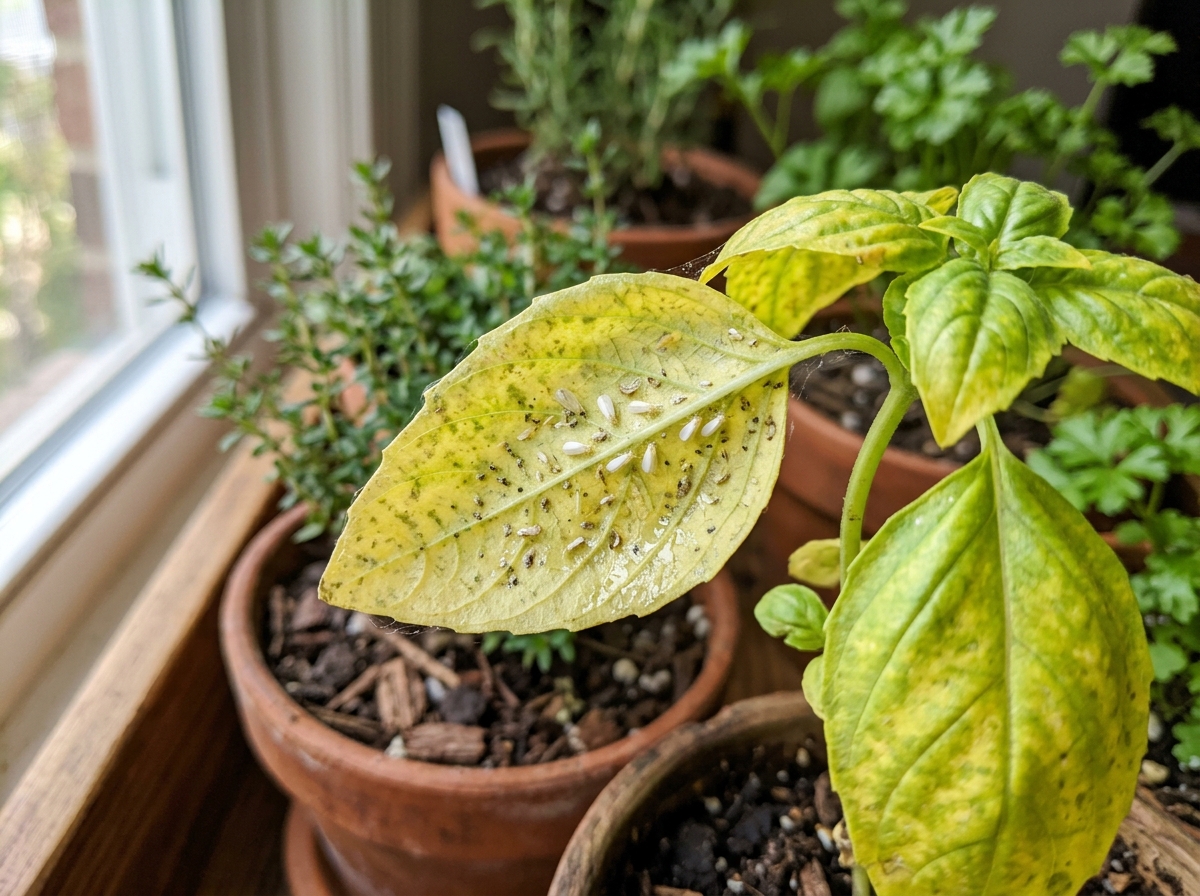
These pests are sap-suckers. They use their needle-like mouthparts to pierce the underside of your basil leaves and drink the life out of them. This leads to a host of problems:
- Plant Wilting and Yellowing: As they drain nutrients, the leaves lose their vibrant green color and begin to droop.
- Honeydew and Sooty Mold: Whiteflies excrete a sticky, sugary substance called honeydew. This isn’t just gross; it acts as a breeding ground for black sooty mold, which can block sunlight and further weaken the plant.
- Virus Transmission: Perhaps most dangerously, whiteflies act as “vectors,” carrying plant viruses from one herb to another, which can devastate an entire indoor garden.
If you are seeing tiny dark spots alongside the white specks, you might be dealing with multiple pests at once. It’s helpful to learn about Identifying the Little Black Bugs Eating Your Herbs and check out our Stop the Sap-Suckers: A Guide to Aphid-Free Herbs to ensure your diagnosis is correct.
Why Basil Whitefly Yellow Traps are the Gold Standard
At Ponto de Arte, we advocate for the most effective yet least invasive methods first. When it comes to whiteflies, yellow sticky traps are the undisputed heavyweight champion.
Scientific research on whitefly trap efficacy shows that in enclosed environments like greenhouses or your kitchen windowsill, these traps significantly suppress adult whitefly populations. By catching the adults, you break the life cycle, preventing the “hundreds of eggs” a single female can lay from ever hatching.
These traps work through a “phototactic response.” Essentially, the insects are hardwired to fly toward specific light wavelengths. Research has shown that wavelengths between 550nm and 590nm (the yellow-to-orange spectrum) are irresistible to them. Using these traps isn’t just about killing bugs; it’s about data. As noted in this Review of yellow sticky traps for decision-making, these tools help you monitor how bad the infestation is so you can decide if further action is needed.
Best of all, they are a cornerstone of Natural Pest Control Methods for Organic Gardening. They involve zero toxins, making them perfectly safe for herbs you plan to eat.
The Science of Yellow Attraction
Why yellow? To a whitefly, a bright yellow card looks like “delicious new foliage.” Because new growth is often a lighter, more yellowish-green than older leaves, the whiteflies have evolved to seek out that specific hue. Efficiency of light traps in greenhouses research even suggests that adding a light source to these traps can further increase their “pulling power,” capturing nearly three times as many adults as a standard trap in some settings.
Benefits for Organic Herb Growers
For those of us obsessed with organic basil, the benefits are clear. Unlike sprays that might linger on the leaves, traps stay in one place. They don’t interfere with the flavor of your herbs, and they are generally safe for the “good guys.” If you are just starting your journey into chemical-free gardening, these traps are a perfect entry point for Natural Pest Control for Beginners.
How to Use Yellow Sticky Traps for Maximum Protection
Buying the traps is only half the battle; placement is where the magic happens. If you put a trap at the base of the pot, you might catch a few fungus gnats, but you’ll miss the whiteflies entirely.
Whiteflies love the underside of leaves and tend to congregate near the top of the plant where the growth is newest and softest. When Growing Basil Indoors, you want your trap to be right in the “danger zone.”
| Feature | Indoor/Greenhouse Use | Outdoor Field Use |
|---|---|---|
| Effectiveness | Highly Effective (Population Suppression) | Monitoring Only (High Migration) |
| Trap Density | 1 trap per 5 square meters | 1 trap per 2-3 linear meters of bed |
| Placement | 15-30 cm above canopy | Near ground, close to plant base |
| Replacement | Every 2-4 weeks (or when full) | Weekly (due to dust and wind) |
Proper Placement of Basil Whitefly Yellow Traps
The “sweet spot” for basil whitefly yellow traps is 15–30 cm (6–12 inches) above the plant canopy. As your basil grows, you must move the trap up. If the trap is buried deep in the foliage, the lack of light exposure and air circulation will make it less visible to the flying pests. For more on the nuances of herb protection, see our guide on Pest Control for Herb Gardens.
Monitoring Populations with Basil Whitefly Yellow Traps
Don’t just hang them and forget them. Use the traps to establish “economic thresholds”—a fancy way of saying “how many bugs are too many?” Research on whitefly population density suggests that counting the number of adults caught each week can tell you if your population is growing or shrinking. If the trap becomes covered in dust or so many insects that there’s no sticky surface left, it’s time for a fresh one.
Beyond the Trap: Integrated Pest Management for Herbs
While traps are great, they are often a “mass trapping” tool that works best as part of a larger plan. If you have a massive cloud of whiteflies, you might need to get physical.
One of our favorite “secret weapons” is the handheld vacuum. Because whiteflies are sluggish in the cool morning air, you can gently shake your basil plants and suck the flying adults right out of the sky. It sounds a bit wild, but it’s incredibly effective for immediate population reduction. This is a common tactic when Aphids on Basil Indoors Are a Real Buzzkill as well.
For long-term control, especially in greenhouses, you can introduce biological allies like Encarsia formosa. These are tiny parasitic wasps (don’t worry, they don’t sting humans!) that lay their eggs inside whitefly larvae, killing them before they can mature. You can also explore DIY Organic Pesticides for Home Gardeners for supplementary sprays.
Combining Traps with Organic Sprays
If the traps aren’t enough, you can “double-tap” the infestation with organic sprays. Neem oil and insecticidal soaps are excellent because they coat the eggs and larvae on the underside of the leaves—the one place the sticky traps can’t reach.
Wait for a cool evening to spray, and always test a single leaf first. You can even find or make a Kitchen Mint Bug Spray for Your Garden that uses essential oils to repel pests while the traps catch the ones that stay.
Prevention and Companion Planting
Prevention is the best cure. Avoid high-nitrogen fertilizers, which produce the succulent, soft growth that whiteflies find irresistible. You can also surround your basil with “repellent” plants. Strong-smelling herbs like mint, cilantro, or even marigolds can help “push” whiteflies away, while your yellow traps “pull” them in. Check out our list of the 10 Best Herbs for Pest Control to Save Your Garden for more ideas. If you’re growing outdoors, you might even consider Netting Your Way to Flea Beetle Freedom to keep larger pests out while focusing your traps on the flyers.
Top Selection Criteria and DIY Basil Whitefly Yellow Traps
When shopping for basil whitefly yellow traps, look for “wet” adhesives that don’t dry out in the sun and are waterproof. Some traps are sold as “banners” or long rolls, which are great for larger herb blocks.
If you’re in a pinch, you can make your own!
- Take a piece of yellow cardstock or paint a piece of plastic bright yellow.
- Coat it with a mixture of petroleum jelly and a little bit of mineral oil (or just plain petroleum jelly).
- Hang it near your plants.
To make your traps even more attractive, you can use “essential oil boosters.” A Scientific study on essential oils and traps found that coating yellow traps with lavender oil significantly increased the number of whiteflies captured on basil. It seems they love the scent of lavender as much as we do—only for them, it’s a fatal attraction.
Frequently Asked Questions about Basil Whitefly Control
How many traps do I need for my indoor basil?
For a standard indoor setup, we recommend one trap for every 5 square meters of growing space. However, if you only have a few pots on a windowsill, one small trap per pot (or one every two pots) is sufficient. The key is proximity; the trap needs to be close enough that a disturbed whitefly sees the yellow “foliage” and heads for it. For more tips, see our guide on Growing Basil Indoors.
Are yellow sticky traps safe for bees and ladybugs?
Generally, yes. Because whiteflies are attracted to the yellow color and are found on the underside of leaves, placing the traps just above the canopy minimizes the risk to pollinators like bees, who are usually looking for flowers. Ladybugs may occasionally get stuck, but the impact is minimal compared to broad-spectrum pesticides.
When should I replace my sticky traps?
We recommend a weekly check-up. If the trap is more than 50% covered in insects or dust, its “reflectance” decreases, making it less attractive to new whiteflies. In a clean indoor environment, a trap can last a full season, but in a dusty greenhouse, you might need to swap them every 7–10 days.
Conclusion
Protecting your herb garden doesn’t have to be a battle of chemistry. By using basil whitefly yellow traps, you are working with nature—using the pests’ own instincts against them. Whether you buy commercial “wet” traps or whip up a DIY version with lavender oil, you’re taking a major step toward a healthier, more productive garden.
At Ponto de Arte, we specialize in helping you keep your aromatic herbs thriving and pest-free. From specialized trap placement to integrated pest management, we have the tools you need to save your basil. For more tips on maintaining your green space, check out our More info about urban gardening services and keep those whiteflies at bay!
