Best Origami Paper: Types, Weights, and When Each One Works
Printer paper, kami, washi, tissue paper, gift wrap: each one solves a problem and creates another. An honest comparison of weight, size, and how many layers each paper can take.
The same model folded from two different papers turns into two different things. One comes out precise, with firm corners; the other springs open by itself, wrinkles in the center, and loses its shape within days. Paper choice matters as much as technique, and there is no single best origami paper, only the right paper for each kind of model.
The Three Factors That Really Matter
Weight. Measured in grams per square meter (gsm), it tells you how heavy the paper is and, indirectly, how thick. For origami, the comfortable range is 60 to 80 gsm. Below that, the paper tears at the points; above 100 gsm, the final layers of a complex model simply will not close.
Crease memory. This is the paper’s ability to hold a fold once it has been pressed. Paper with good memory keeps a model in shape for years; poor paper relaxes and opens. Napkins and toilet paper sit at the bad end; traditional Japanese paper sits at the good end.
Tensile strength. How much pulling the paper can take before it breaks. It matters in models that require opening layers, inflating, or pulling points outward.
Comparing the Most Common Papers
| Paper | Typical weight | Best for | Limitation |
|---|---|---|---|
| Printer/copy paper | 75 gsm | Practice, models with few layers | Thick for complex models |
| Kami (standard origami paper) | 60 to 70 gsm | Almost everything; it is the default in diagrams | Colored on one side only |
| Tant | 78 gsm | Models with curves and volume | More expensive, harder to find |
| Washi / chiyogami | Varies | Gift and display pieces | High price; the print can compete with the form |
| Tissue paper | 20 to 30 gsm | Models with many layers | Tears easily |
| Gift wrap | 50 to 90 gsm | Decorations in quantity | Quality varies a lot between rolls |
| Light cardstock | 120 to 180 gsm | Boxes, structures that need to stand | Not suited to fine folds |
Printer Paper: The Practice Paper
Cheap, available everywhere, and with reasonable crease memory. The limitation shows up when a model stacks layers: in an origami crane (tsuru) folded from a 6-inch (15 cm) square, the core ends up with sixteen layers of 75 gsm paper and the final point does not close properly. The simple fix is to use printer paper in larger squares, 8 inches (20 cm) and up.
Because it comes in rectangular sheets, US Letter (8.5 x 11 in) or A4, it needs a cut before you start. The process is covered in how to cut a perfect square, with and without a ruler.
Kami: The Standard
This is the paper sold in packs of colored squares, usually white on one side. Thinner than printer paper and with good memory, it is the unspoken reference for most diagrams: when a tutorial says “6 x 6 inches” or “15 x 15 cm” with no further detail, it means kami.
Being colored on one side only is a feature, not a flaw. Several traditional models use it on purpose, showing the white on an animal’s muzzle or at the center of a flower.
Washi and Chiyogami: Paper for Gifts
Washi is traditional Japanese paper, made from the long fibers of plants such as kozo, which gives it far more strength than ordinary wood-pulp paper. Chiyogami, or yuzen, is washi decorated with printed patterns.
These are expensive papers, and they are worth it for pieces that will last or be given away. For practice, they are a waste. One note on composition: very dense prints compete for attention with the form of the model. In general, the more complex the origami, the plainer the paper should be.
Tissue Paper: For Models with Many Layers
At 20 to 30 gsm, it solves the bulk problem in complex models, but it tears easily. Advanced folders often treat it with methylcellulose to gain stiffness without losing thinness, a procedure that makes no sense for someone just starting out.
Size: Why 6 x 6 Inches Became the Standard
The 6-inch (15 cm) square is the most widely sold size and the one most diagrams assume. It balances two things: enough area for precise folds and a reasonable finished size for the model.
For beginners, though, larger squares are easier. At 8 or 10 inches (20 or 25 cm), every fold has more margin and alignment errors become proportionally smaller. It is worth sizing up while you learn and returning to 6 inches later.
Squares of 3 inches (7.5 cm) exist for miniatures and for people who already know the model well. Starting on them is a recipe for frustration.
Tip
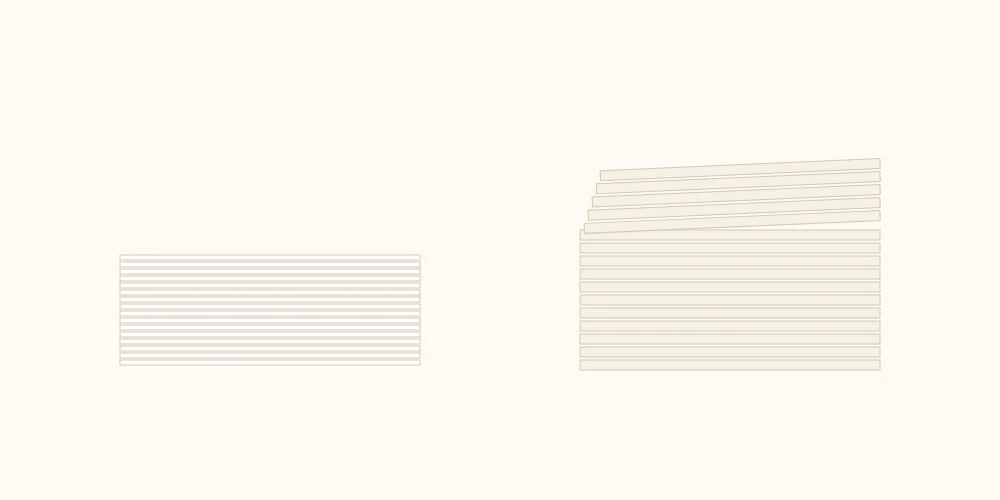
For origami lucky stars, the format changes completely: instead of squares you need narrow strips, and the ratio of width to length matters more than the type of paper.
A Quick Test Before You Buy
If you have the paper in hand and are not sure it will work, do this:
- Fold it in half and run your fingernail firmly along the fold.
- Open it and look at the crease. If it has turned white and brittle, the paper is too fragile and will tear at the points.
- Fold the same sheet into eight layers, accordion style, and press. If the stack springs open when you let go, the crease memory is poor.
- Gently pull on a folded corner. If it tears without effort, rule it out for models that require opening layers.
The test is quick and keeps you from buying a whole pad of paper that will not work.

What to Avoid
- Laminated or varnished paper. It does not hold a crease: the fold slips and springs back.
- Cardstock above 180 gsm. Fine for boxes, not for folding.
- Thick recycled paper. The short fibers break at the crease, especially in reverse folds.
- A sheet that is already crumpled. Old creases are false guides; the paper starts folding itself in the wrong place.
How to Store It
Paper that is going to be folded needs to be flat and dry. Stored upright in a damp closet, it warps at the edges within weeks and the square stops being square.
A rigid folder or a flat box, kept horizontal, takes care of it. If the paper has already warped, you can still use it: press it under books for a day or two before folding.
If the model keeps coming out crooked even with suitable paper, the problem is probably somewhere else in the process. The list of common origami mistakes covers the most frequent causes.
Which Paper for Which Model
A quick reference, organized by what the model demands and not by the name of the paper:
| Type of model | What it demands | Recommended range |
|---|---|---|
| Many layers (crane, lotus) | Thinness | 60 to 70 gsm |
| Inflated models (bunny, balloon) | Tensile strength | 60 to 80 gsm |
| Structures that stand (box, envelope) | Stiffness | 100 to 140 gsm |
| Spring-loaded models (jumping frog) | High crease memory | 120 gsm or more |
| Light pieces for hanging (butterfly) | Lightness | 60 to 70 gsm |
| Everyday use (bookmark) | Resistance to handling | 90 to 120 gsm |
How to Find the Weight Without the Packaging
If the paper came loose and you do not know its weight, you can estimate by comparison. Take a sheet of ordinary printer paper, which is almost always about 75 gsm, and compare the two by feel and by how much light passes through them.
A slightly more precise method, if you have a kitchen scale: cut a 10 x 10 cm square of the paper (just under 4 inches per side), weigh it, and multiply the result in grams by one hundred. A 10 cm square that weighs 0.75 g corresponds to 75 gsm. If that is below the resolution of your scale, stack ten squares and divide the weight by ten.
Where to Look
Proper origami paper turns up most often in three places: stores that carry school and office supplies, which usually stock basic packs of 6-inch squares; craft stores, which have a wider range of weights and prints; and specialty or online retailers, where you can find kami, tant, and washi.
Check two things before buying a large pack: whether the squares are actually square, since cheap packs sometimes have uneven cuts, and what the weight is, which is not always printed on the packaging. When in doubt, buying the smallest pack available and testing it costs less than finding out later that the paper does not work.
Tip
Scrapbook paper, sold in craft stores in 12 x 12 inch (30 x 30 cm) sheets, usually falls between 120 and 180 gsm. It is expensive for practice and thick for complex models, but it is excellent for boxes, envelopes, and any piece that needs to stand up.
Frequently asked questions
What paper weight is best for origami?
Between 60 and 80 gsm works for almost everything. Below that the paper crumples and tears at the points; above 100 gsm the final layers do not close, and models with many folds get bulky in the center.
Can I use regular printer paper?
Yes, and it is what most people practice with. It averages about 75 gsm, holds a crease well, and is cheap. The limit shows up in models with many layers, such as a crane folded from small paper: the core gets thick and the final point does not close.
What is the standard size of origami paper?
The most widely sold is the 6 x 6 inch (15 x 15 cm) square, and most diagrams assume that size. It is also common to find 3 x 3 inch (7.5 x 7.5 cm) squares for small models and 8 x 8 inch (20 x 20 cm) or 10 x 10 inch (25 x 25 cm) squares for beginners who want more area to work with.