Origami Mobile: How to Build, Balance, and Hang One
Balancing a mobile is simple geometry: even weight at the ends, thread at the center of mass. This guide covers piercing, knots, spacing, and how to keep the pieces from spinning into each other.
Tutorial at a glance
Materials
- 5 to 12 origami pieces, already folded
- Nylon line or thin cotton thread
- Fine needle
- Wooden rod, bamboo stick, or embroidery hoop
- Removable tape or an adhesive hook
A badly assembled origami mobile is easy to spot: the pieces spin into each other, the strings tangle, and the whole thing hangs to one side. None of those problems has anything to do with the quality of the folding. They come down to where you pierce, how you space, and where the balance point sits.
Get those three things right and any set of origami pieces becomes a mobile that works.
Choosing the Pieces
Not every model works hanging. What matters is the profile: the piece will be seen from the side, turning slowly.
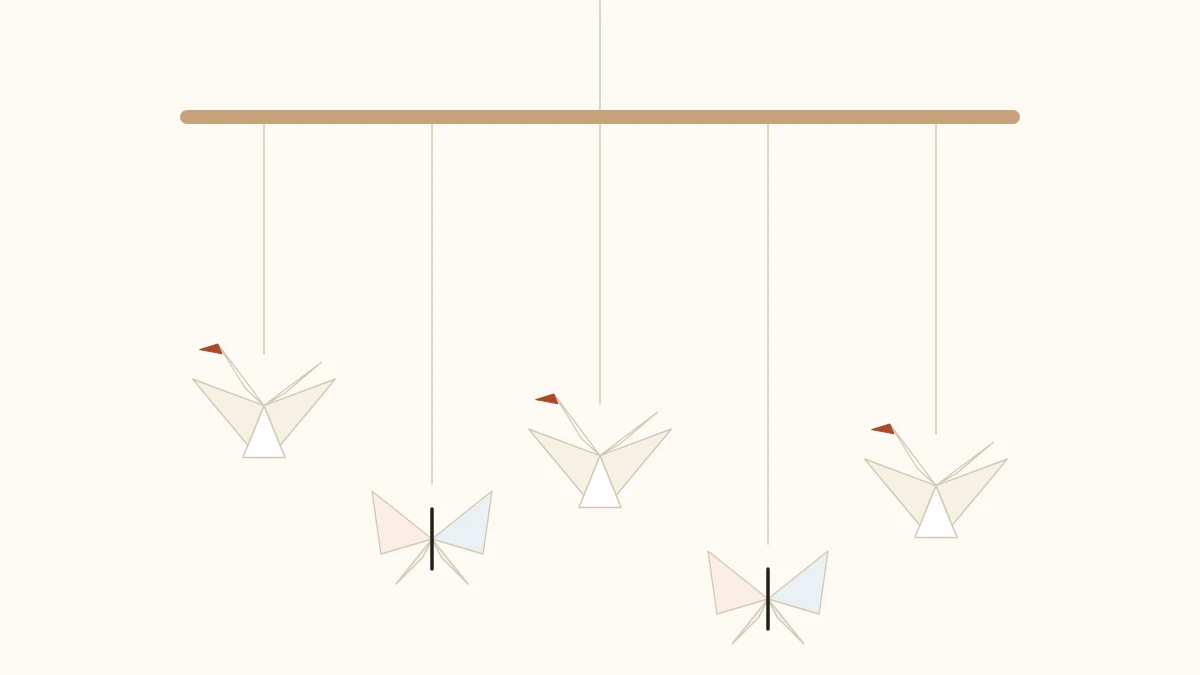
- Work well: the crane (tsuru), butterflies, whales, and lucky stars, all silhouettes you can recognize from any angle.
- Work poorly: boxes, large flat models, and any piece that only looks good from the front.
Five to twelve pieces is the comfortable range. Fewer looks incomplete; more calls for a structure with several levels.
Where to Pierce Each Piece
The hole has to sit at the piece’s balance point, or it will hang crooked. To find that point, rest the model on your fingertip and look for the spot where it stays steady. That is where the thread goes in.
| Piece | Where to pierce |
|---|---|
| Crane | Center of the back, between the wings |
| Butterfly | In the body, at its highest point |
| Whale | On the back, about a third of the way from the head |
| Lucky star | Straight through from point to point, with a needle |
Use a fine needle and nylon line or thin cotton thread. Tie a knot big enough that it will not slip through the hole, or pass the needle twice through the same spot, which spreads the tension better and keeps the paper from tearing.
Tip
A drop of white glue on the hole, on the inside of the piece, keeps the paper from tearing over time. Let it dry before hanging.

The Frame
Three options, from simplest to most involved:
Single rod. A bamboo skewer, a dry twig, or a wooden dowel. The pieces hang down on threads of different lengths. It is the easiest setup to balance and the best place to start.
Embroidery hoop. The wooden ring arranges the pieces in a circle and comes with a natural suspension point. It is a great choice for nursery mobiles because it turns evenly.
Two crossed rods. Two rods tied in a cross, with pieces at all four ends and one in the center. It looks better and is much harder to balance, since every piece you add shifts the center of mass of the whole thing.
Spacing: The Detail That Stops the Tangling
Pieces at the same height touch and tangle. The rule of thumb: no two neighboring threads should be the same length, and the difference between them has to be greater than the width of the largest piece.
In a mobile with five cranes of about 3 inches (8 cm) in wingspan, for example, the threads could be roughly 5, 7, 10, 12, and 15 inches (12, 18, 25, 31, and 38 cm). The pieces sit at distinct heights and turn without colliding.
Along the rod, space the tie points unevenly as well. Regular spacing gives a mechanical look; irregular spacing looks more natural.
Finding the Balance
- Tie all the pieces to the rod, leaving the knots loose enough to slide.
- Tie a spare thread around the middle of the rod and lift the whole mobile by it, holding it in the air.
- Watch which way the mobile tips and slide the suspension thread in that direction, a little at a time, until the rod sits horizontal.
- Only then tighten the knots, starting with the suspension knot.
If one end is still too heavy with the thread moved as far as it can go, swap a piece to a different spot instead of forcing it. It is faster.
How to Hang It
- Adhesive ceiling hook, for light loads. A paper mobile rarely weighs more than about 2 ounces (50 g).
- Thumbtack or thin nail, if the ceiling is wood or drywall.
- Plant hanger or wall bracket, when you cannot put a hole in anything.
Height matters: a mobile needs to sit above head level in walkways but low enough to be seen up close. In a child’s room, 20 to 28 inches (50 to 70 cm) above the bed usually works, and always out of reach of little hands.
Watch out
Over a crib, a mobile must be completely out of the baby’s reach and should be taken down as soon as the child can stand or pull on objects. Thread and small paper pieces are a hazard if they can be reached.
What Makes the Mobile Turn
Air currents do the work, but so does the thread: nylon line twists and untwists, which keeps the movement going longer than thick twine does.
If the mobile hangs still, it is probably too heavy for the air movement in the room. Smaller pieces in thinner paper solve that, which is a good argument for folding the models from 3-inch (7.5 cm) squares when they are headed for a mobile.
Two-Level Mobile
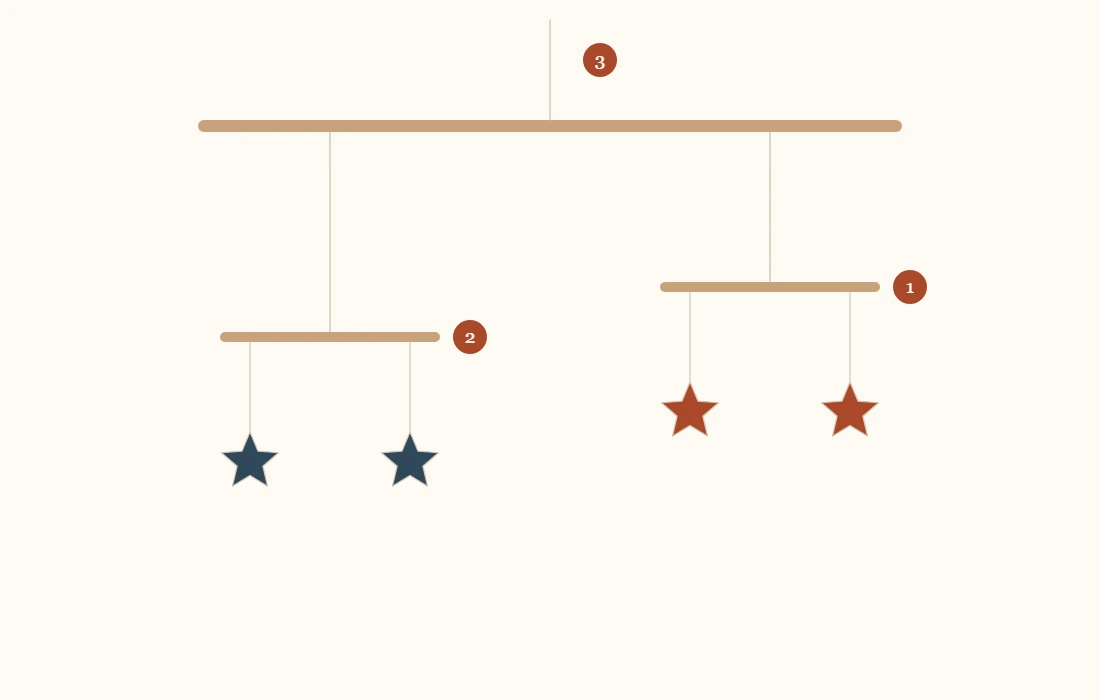
After the single-rod version, the next step is the articulated mobile, where smaller rods hang from a main one. It moves much more, because each level turns independently.
Assembly has to follow a specific order, from the bottom up:
- Assemble and balance each small rod on its own, with its pieces already hanging. Treat each one as a complete mobile.
- Hang the small rods from the main rod, at points away from the ends.
- Balance the main rod last, sliding the suspension thread until it sits horizontal.
Trying to balance everything at once does not work: any adjustment on one level shifts the center of mass of all the others. Building from the bottom up, each level arrives at the next one already finished.
Tip
Always leave a vertical gap between levels that is greater than the length of the largest piece. Without it, the lower rods knock into the upper pieces when the mobile turns.
Combinations That Work
A few sets with a consistent theme, handy when you are short on ideas:
| Theme | Pieces | Suggested paper |
|---|---|---|
| Ocean | Whales in three sizes | Blues in different shades |
| Garden | Butterflies and small flowers | Small prints and warm colors |
| Peace | Five to nine cranes | White, or a single color |
| Christmas | Lucky stars and small trees | Green, gold, and red |
In any of them, sticking to a single color family usually works better than using every color in the pack. Movement is already the element that draws the eye, and the palette does not need to compete with it.